

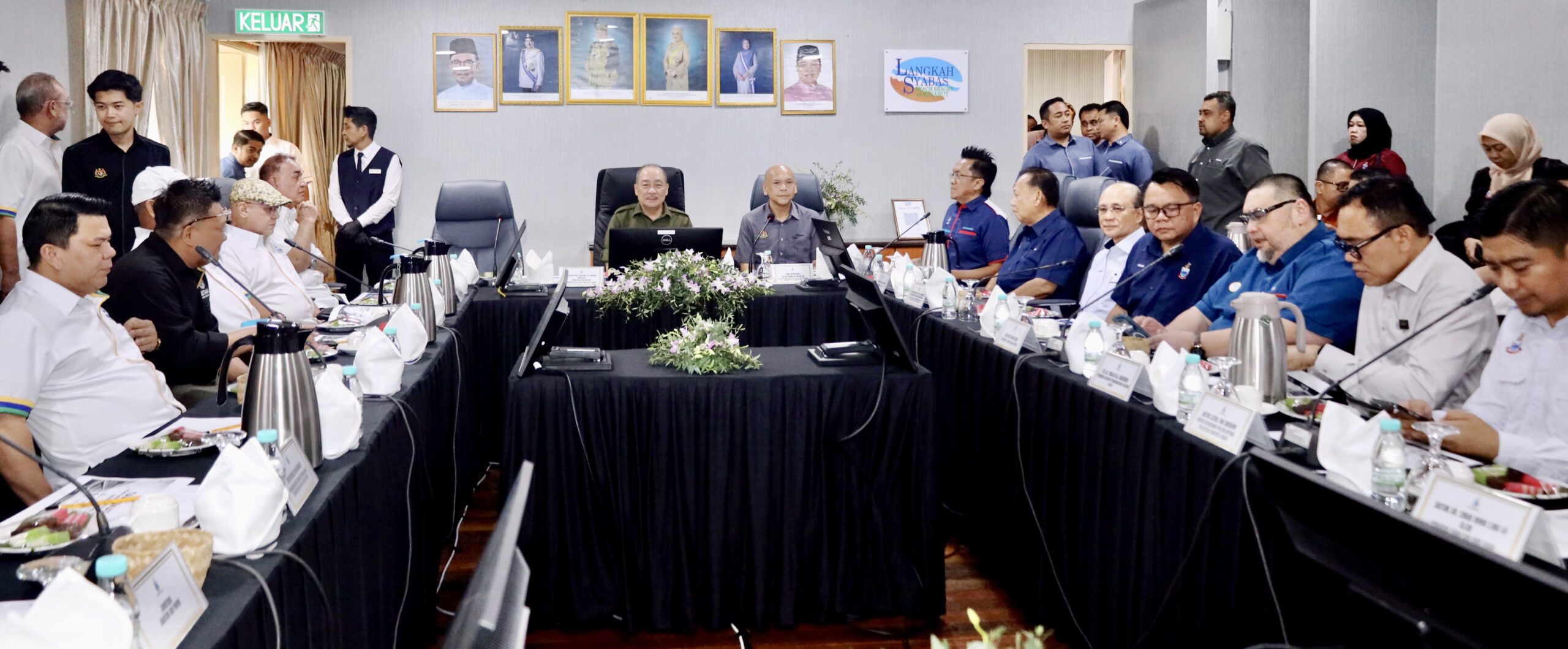
Hajiji, Armizan and other officials listen to a briefing by Chee (third right) on the progress of the Kogopon Water Treatment Plant and Kabang Water Intake projects.
PAPAR: The 80-million-litres-per-day (MLD) Kogopon Water Treatment Plant (WTP) and the new Kabang Raw Water Intake are expected to be operational in November and August this year, respectively, providing a major boost to water supply in Papar, Putatan and Kimanis.
The two projects are expected to help address the longstanding water shortage affecting the three areas.
Chief Minister Datuk Seri Haji Hajiji Haji Noor directed the State Water Department to closely monitor both projects and ensure they are completed without further delays.
“Be more proactive in handling water shortage issues by sending water tanks to affected areas, not only here but throughout the State.
“The water supply problem is a legacy issue, but as a responsible government, we are committed to addressing it,” he said after receiving a briefing on the two projects at Langkah Syabas Resort here today.
Earlier, State Water Department Director Chee Chun Chieh told the Chief Minister that the RM365.9 million Kogopon WTP is scheduled to begin supplying treated water by the end of November.
Also present were Deputy Chief Minister I cum Works and Utilities Minister Datuk Seri Dr Joachim Gunsalam and Domestic Trade and Cost of Living Minister Datuk Armizan Mohd Ali, who is also Papar Member of Parliament.
Although the entire Kogopon WTP project is expected to be fully completed by 2028, Chee said the plant will begin supplying water before the end of this year to meet demand in Papar, Putatan and as far as Kimanis.
On the RM39.73 million Kabang Water Intake project, Hajiji was informed that construction has reached 90 per cent completion and the facility is expected to be commissioned by September this year.
The new intake, built further upstream along the Papar River in Kabang, will increase raw water capacity from nine MLD to 30 MLD. It was relocated upstream to overcome salinity problems that have frequently affected the existing Emergency Water Supply Scheme (EWSS) Treatment Plant and its water intake at Limbahau.