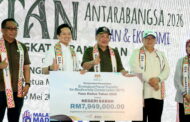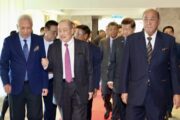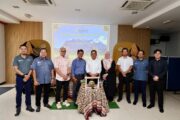


Goh (sixth right) receiving a souvenir from Rosmadi (seventh right), while Wong (fifth right), Yong (fourth right), Chan (right), Fung (second right), Chen (third left) and others look on.
KOTA KINABALU: Sabah’s excellent marine geographical location can be vigorously developed with the assistance of the Federal Government, in all aspects, to promote the Blue Economy and accelerate the Sabah Maju Jaya (SMJ) process, said the Federation of Chinese Associations Malaysia (Huazong) President Tan Sri T C Goh.
Goh, who is also President of the Federation of Chinese Associations Sabah (FCAS), said Sabah’s 37,300 square kilometres of marine area, 116,800 square kilometres of continental shelf area, and the country’s longest coastline (2,383 kilometres), including over 1,000 kilometres of coastline, hold great potential for fish farming and other marine products, possessing innate advantages for developing the Blue Economy.
He said as the Federal Government has included the Blue Economy in the 12th Malaysia Plan (2021-2025) as one of the areas for revitalising the national economy, the Sabah Government also plans to explore the potential of the Blue Economy in this year’s budget to drive economic development, create more job opportunities, and improve people’s living standards through relevant plans.
Goh, who is also a member of the Sabah Economic Advisory Council (SEAC) said this when speaking at the “Sabah Blue Economy” exchange meeting hosted by Datuk Haji (Datu) Rosmadi Datu Sulai, Chief Coordinator of the Secretariat of Sabah Maju Jaya (SSMJ). Also in attendance were FCAS Deputy President Datuk Susan Wong Siew Guen, its four Vice Presidents Kapitan Fung Chun Fatt, David Chan, Ng Young Wah and Chang Jeng Yung, Secretary-General, Datuk Yong Soo Pin and Treasurer-General Chen Ee Sheng and Vice Youth Chief Regina Ngu, among others.
Goh pointed out that the United Nations (UN) proposed the concept of the Blue Economy in 2012, aiming to promote global sustainable use of marine resources to promote economic growth, improve living standards and create employment opportunities for people, while maintaining the sustainability of marine ecosystems. At the ASEAN meeting held in Brunei in 2021, countries including Malaysia agreed to promote this plan in the ASEAN region.
He said that the Huazong and FCAS fully support the Federal and Sabah Governments in promoting various people-friendly policies, including building a sustainable future through the implementation of the blue economy.
Meanwhile, Rosmadi emphasised the importance and potential of the Blue Economy development and said the Sabah Government hopes to gain full cooperation from the people and various enterprises for this plan.
He further noted that Chief Minister Datuk Seri Haji Hajiji Haji Noor had during an event held in Shenzhen, China on November 6 last year, announced the Blue Economy plan, and invited Chinese investors to participate in related fields.
He added that the Sabah Government also plans to hold the “Sabah International Blue Economy Conference” (SIBEC) from September 2 to 4 this year, with the opening ceremony to be officiated by Prime Minister Datuk Seri Anwar Ibrahim, aimed at promoting global understanding and cooperation on the blue economy.
The meeting and exchange session also introduced the definition of the Blue Economy, which is the sustainable use of marine and coastal resources to bring equal and inclusive benefits to people, to protect and restore the health of marine ecosystems, enhance resilience, and contribute to achieving sustainable development goals, etc.
The meeting also emphasised the important components of the Blue Economy, including the utilisation of biological and non-biological resources, marine business and trade, and the importance of addressing challenges to marine health. At the same time, the meeting also raised issues to be addressed, including governance, benchmarking, financing, incentives, and emphasised the reliability, renewable ability, and resilience of the Blue Economy, painting a bright future for the sustainable development of Sabah.