

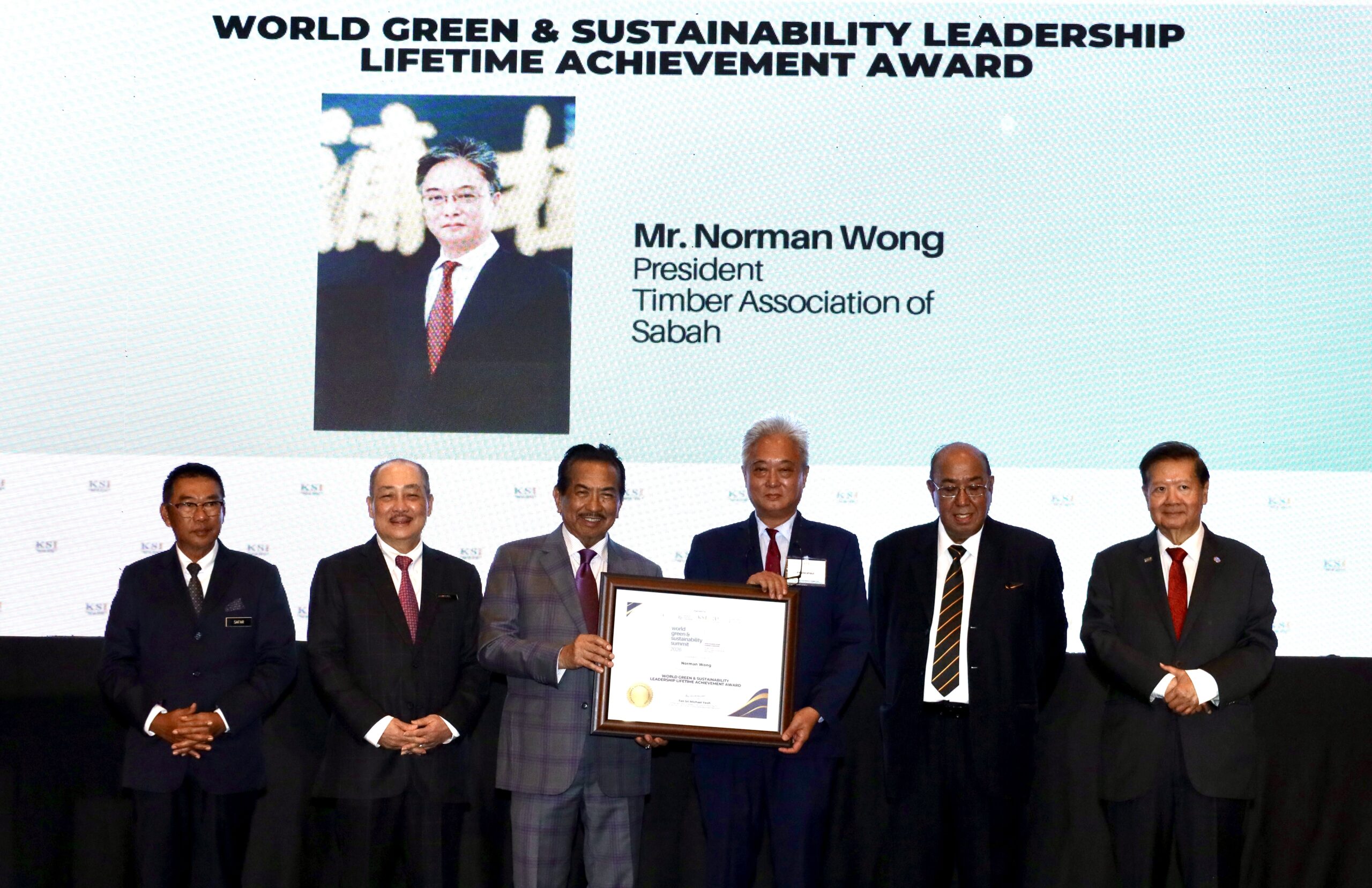
Head of State Tun Musa Aman presenting the World Green and Sustainability Leadership Lifetime Achievement Award to Sabah Timber Association President Norman Wong while Hajiji and other dignitaries look on.
KOTA KINABALU: Chief Minister Datuk Seri Haji Hajiji Haji Noor has assured that the State Government will continue to act as a responsible custodian of Sabah’s environment, while firmly safeguarding the economic future of its people.
“This is the balance Sabah seeks. This is the future Sabah is building,” he said at the World Green and Sustainability Summit (WGSS) at Shangri-La Tanjung Aru Resort here today.
He said Sabah fully supports renewable energy and stronger environmental protection, but stressed that the state remains a developing economy.
“We are strengthening infrastructure, expanding industrial capacity, creating jobs and improving energy security for long-term growth. Our position is clear,” he said.
Hajiji noted that energy is not merely an environmental issue, but also an economic concern and a matter of long-term security for Sabah, making a balanced and practical energy mix essential.
“Renewable energy is clearly part of our future. Solar, hydro, biomass, biogas and other clean technologies must continue to expand as part of Sabah’s long-term energy roadmap.
“The Sabah Energy Roadmap and Master Plan 2040 emphasises reliable, accessible, affordable and sustainable energy, including improving generation reserve margins, enhancing the energy mix and increasing the contribution of renewables,” he said.
Hajiji also raised the question of whether Sabah is receiving fair economic value for the significant environmental responsibility it carries on behalf of the nation.
“This is not a selfish question. It is a fair question. Conservation is often seen as a moral duty, and it is a responsibility we take seriously. But conservation also comes with economic costs.
“When land is preserved, there is an opportunity cost. When forests are protected, there is revenue foregone. When ecosystems absorb carbon and support biodiversity, the value created benefits not only Sabah, but Malaysia, the region and the world,” he said.
He stressed that the evolving sustainability agenda must also address issues of fairness.
“It must involve fair value, fair recognition, fair investment and fair participation.
“Sabah cannot continue to be seen only as a contributor of natural capital. Sabah must also become a beneficiary of that natural capital,” he said.
He added that Sabah can demonstrate that a developing state does not have to choose between protecting the environment and improving livelihoods.
“We can do both, but we must do it in a way that is right for Sabah,” he said.