

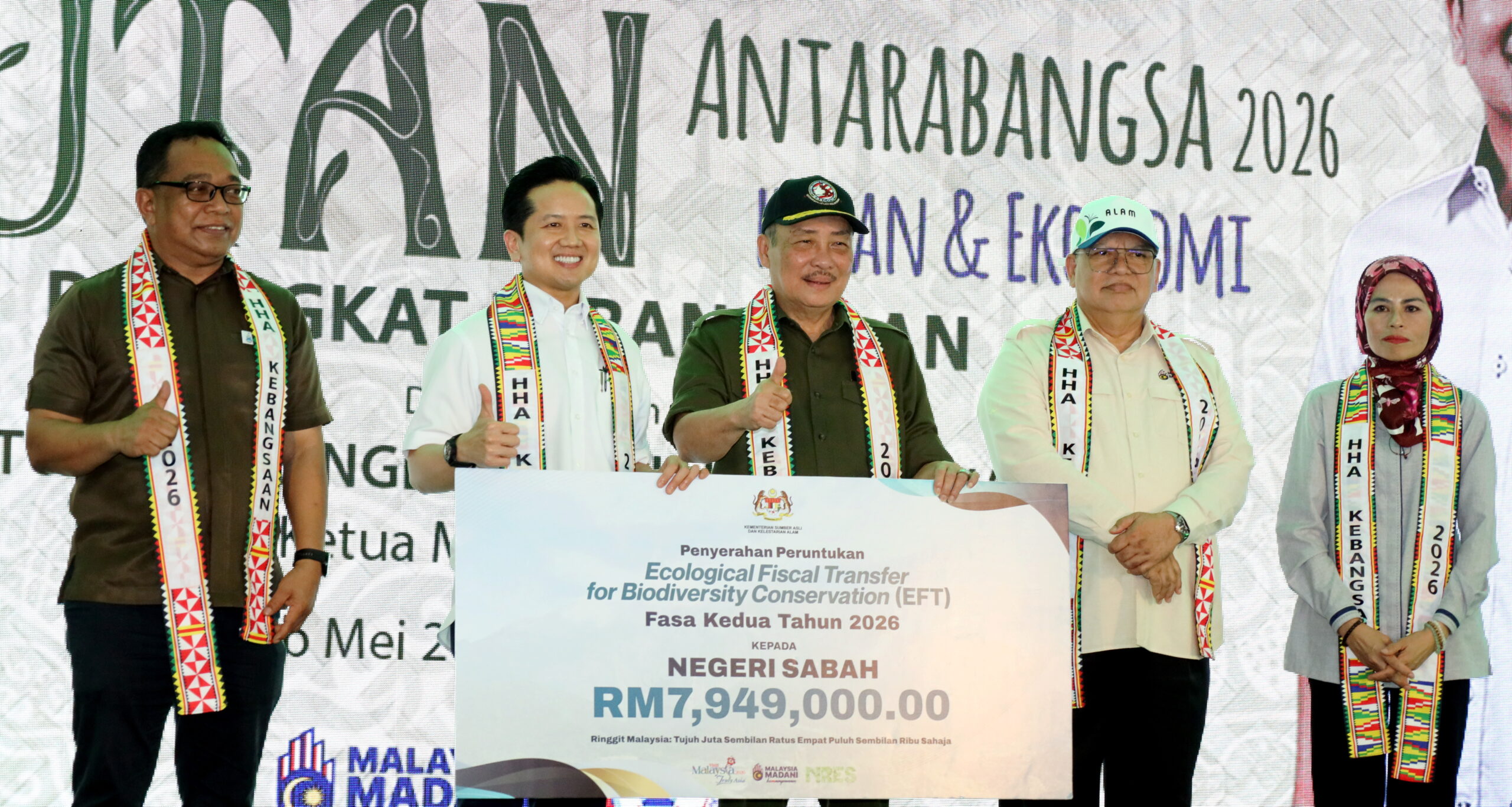
Hajiji (centre) receiving the RM7.95 million Ecological Fiscal Transfer (EFT) fund (second phase) on behalf of the State Government from Arthur.
SOOK: Sabah continues to maintain its status as a net carbon sink or carbon-negative state based on greenhouse gas inventory data and the latest reports, said Chief Minister Datuk Seri Haji Hajiji Haji Noor.
He said this status is supported by the significant forested areas in the state, which contribute greatly to the nation’s carbon absorption capacity.
According to him, the role of forests in reducing the impact of global warming caused by climate change has become increasingly critical as forests function as “carbon sinks”, namely areas that absorb more carbon dioxide released into the atmosphere, thereby helping to stabilise the global climate system.
He said forests identified as contributors to carbon-related activities, particularly peat swamp and mangrove forests, can also be expanded within the natural economy sector in line with the development of the Blue Economy and Green Economy at the state level.
He added that an inclusive forest management approach involving local communities is capable of achieving a balance between environmental conservation and the socio-economic wellbeing of the people.
This is evident through initiatives by the Sabah Forestry Department in implementing projects with local communities under the Forest Restoration Project Fund, he said.
These community-based programmes include reforestation of degraded forests through a forest landscape restoration approach, rehabilitation of water catchment areas, as well as the development of alternative income sources based on non-timber forest products such as kelulut honey and rattan.
The State Government’s efforts are also supported through continuous allocations under the 13th Malaysia Plan (13MP) and the Ecological Fiscal Transfer (EFT) Fund, he said.
“I was informed that under Rolling Plan One (RP-1), the Sabah Forestry Department has been allocated RM70.8 million for the implementation of forestry projects in Sabah during the 13MP period.
“Through the EFT as well, Sabah is among the largest recipients of funds, amounting to RM126.36 million since 2019. These funds have been used to implement biodiversity conservation projects. This also reflects the Federal Government’s recognition of the conservation efforts carried out in this region,” he said when officiating at the opening of the National International Forest Day celebration at Dataran Sook today.
Hajiji said the International Forest Day theme, “Forests and Economy”, is highly appropriate in highlighting the role of forests not only as a natural treasure, but also as a driver of sustainable economic growth.
Meanwhile, he welcomed the selection of Sook district as the host for the celebration outside the state capital, saying it provides an opportunity for people in the interior to jointly celebrate International Forest Day at the national level.
“This is certainly due to the initiative and strong support from Dato’ Sri Arthur Joseph Kurup, Minister of Natural Resources and Environmental Sustainability Malaysia.
“It is also timely as Sook was only recently upgraded and gazetted as a full district in April last year, and today it is honoured to host the National-level International Forest Day celebration. Congratulations to the district and the people of Sook,” he said.