

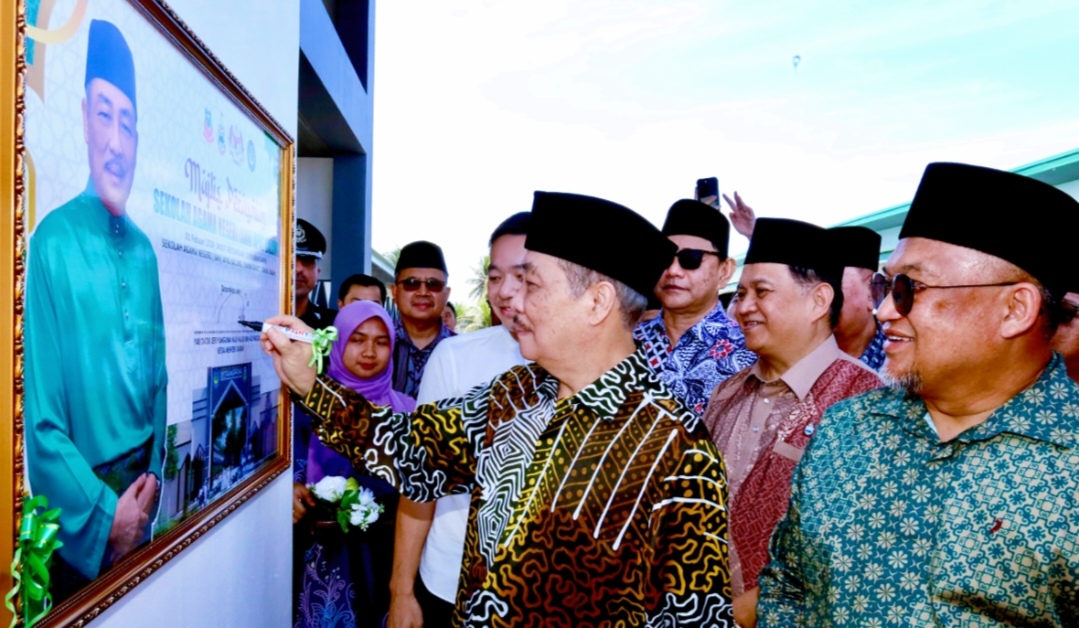
Hajiji signing the plaque to officially open the new Apas Balung State Religious School (SAN) at Taman Sawit Balung, Tawau, today.
TAWAU: The State Government will monitor the impact of the electricity tariff increase on consumers following the implementation of the rate review in Sabah and Labuan, effective February 1, 2026.
Chief Minister Datuk Seri Haji Hajiji Haji Noor said the increase experienced by consumers would be minimal and not burdensome.
“We will constantly monitor the impact, but I believe the effect is only slight. If one currently pays RM100, the increase is only be about RM15. So, it is not very burdensome if an additional RM15 ensures a stable electricity supply , that is the rationale behind the tariff hike,” he told reporters after officiating the Apas Balung State Religious School (SAN) at Taman Sawit Balung here today.
He was responding to questions regarding the Sabah Electricity Sdn Bhd’s tariff review beginning February 1, which involves an adjustment from an average base rate of 34.52 sen/kWh to 39.70 sen/kWh.
The Chief Minister explained that the new rate was approved by the State Cabinet, taking into account the current needs in Sabah.
“Tariffs in Sabah are relatively low compared to Peninsular Malaysia. We are only increasing it by five sen or 15 per cent, which is not very burdensome for the ordinary citizens who make up about 70 to 80 per cent of the population in Sabah.
“This is unavoidable because we are bearing high costs for various factors now. It is necessary for us to overcome these challenges,” he said.
Hajiji said that the Federal Government currently provides an electricity subsidy for Sabah amounting to approximately RM700 million annually or RM3.5 billion over five years.
“We cannot continue this way indefinitely. A small increase of five sen can help reduce the subsidies provided by the Federal Government,” he added.
He said that the State Cabinet agreed to the proposal submitted by the Energy Commission of Sabah (ECoS) and Sabah Electricity after considering the rising operational costs of power generation in the state.
Meanwhile, regarding SAN Apas Balung, Hajiji said he was impressed by the efforts to build the school, which was completed in just three months through contributions from various parties.
This serves as a beginning for the school’s development, which will be followed by government assistance for future expansion.
He said he was also impressed by the school management’s initiative to utilise Artificial Intelligence (AI), in line with current developments in education.
“I am impressed. This is the first religious school to use AI. This is the era we are moving into where technology is highly advanced, and this applies not just to regular schools but to religious schools as well,” he said.
Hajiji said that the State Government also supports the school management’s proposal to establish a religious secondary school to ensure the continuity of religious education for its students.
“It is an excellent proposal because we believe religious secondary schools need to be expanded or increased in Sabah, as the demand from the Muslim community for religious secondary education is very high. Thus, the planning is very good, secondary schools, and perhaps eventually an Islamic university and so on,” he added.
Also in attendance were Local Government and Housing Minister and State Religious EXCO Datuk Dr Mohd Arifin Mohd Arif; Education, Science, Technology and Innovation Minister Datuk James Ratib and Youth, Sports Development and
Creative Economy Minister Datuk Nizam Abu Bakar Titingan.
Later, the Chief Minister, who performed Zohor prayers at Al-Ansar Mosque in Taman Sawit Balung, also presented contributions from the Zakat Division to eligible needy recipients.