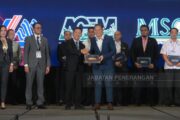



Mohd Faizal Malik
KOTA KINABALU: Sabah should focus on developing industries that generate sustainable cargo instead of simply trying to attract more vessels to its ports.
Chartered Institute of Logistics and Transport (CILT) Sabah Section Deputy Chairman Ts Mohd Faizal Malik said vessel calls were ultimately driven by cargo, trade flows and commercial opportunities rather than port infrastructure alone.
He noted that the State needed to rethink how it approached port development and maritime connectivity by first asking what industries could generate cargo and, subsequently, what shipping services would be needed to move it.
“Cargo creates vessels. Industries create cargo,” he said, stressing that port development should be closely linked to Sabah’s industrialisation strategy.
According to Mohd Faizal, the focus should shift from simply counting vessel calls to looking at the volume, value and sustainability of cargo moving through the ports.
He said Sabah had significant potential in sectors such as palm oil downstream processing, biomass and renewable energy, food and agro-processing, fisheries and cold-chain logistics, halal manufacturing and energy-related industries.
“These industries do not merely occupy industrial land. They create imports, exports, storage, trucking, warehousing, handling and marine services, which in turn generate demand for vessel calls,” he said in a statement.
Mohd Faizal said this approach was particularly important for industrial hubs such as Palm Oil Industrial Cluster (POIC) Lahad Datu, where the port and industrial park should be developed as an integrated commercial ecosystem.
He said investors should be offered more than industrial land, with the proposition built around reliable access to raw materials, processing facilities, storage, logistics, port services and export markets.
“An investor will ask whether raw materials can be brought in reliably and whether finished products can be exported competitively. That is where the real value of an industrial port lies,” he stressed.
Mohd Faizal also pointed out that ports were increasingly competing as part of wider supply chains rather than simply against other ports, adding that Sabah’s competitiveness should therefore be viewed through a combination of land, utilities, labour, industrial capabilities, logistics, port infrastructure, shipping connectivity and access to markets.
He proposed that Sabah consider developing a Statewide Cargo Development Strategy to identify potential cargo sources and determine the infrastructure and shipping requirements needed to support them.
Such a strategy, he explained, should map industries, cargo volumes, origins and destinations, seasonality, transport modes, vessel types, ports, infrastructure requirements and potential revenue.
For POIC Lahad Datu, this could include assessing the cargo potential of the eastern Sabah industrial corridor and its links with markets in the BIMP-EAGA region, he added.
“Instead of waiting for shipping lines to tell us what cargo they have, we should work backwards from industrial investment opportunities and identify the cargo that we can create,” he said.
Mohd Faizal said closer coordination was needed among government agencies, port operators, industrial park developers, investors, manufacturers, logistics companies and shipping lines.
“Port planning must become part of industrial policy. Industrial policy must consider logistics, and logistics policy must consider maritime connectivity. These three elements cannot be developed separately,” he said.
He said the ultimate goal should be to turn Sabah’s ports from infrastructure assets into economic platforms that connect industries to regional and international markets.
“Rather than measuring our ambition by how many vessels we can attract, we should measure it by how much economic activity we can create that makes those vessels want to come,” he said.