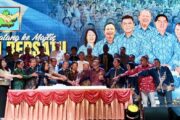


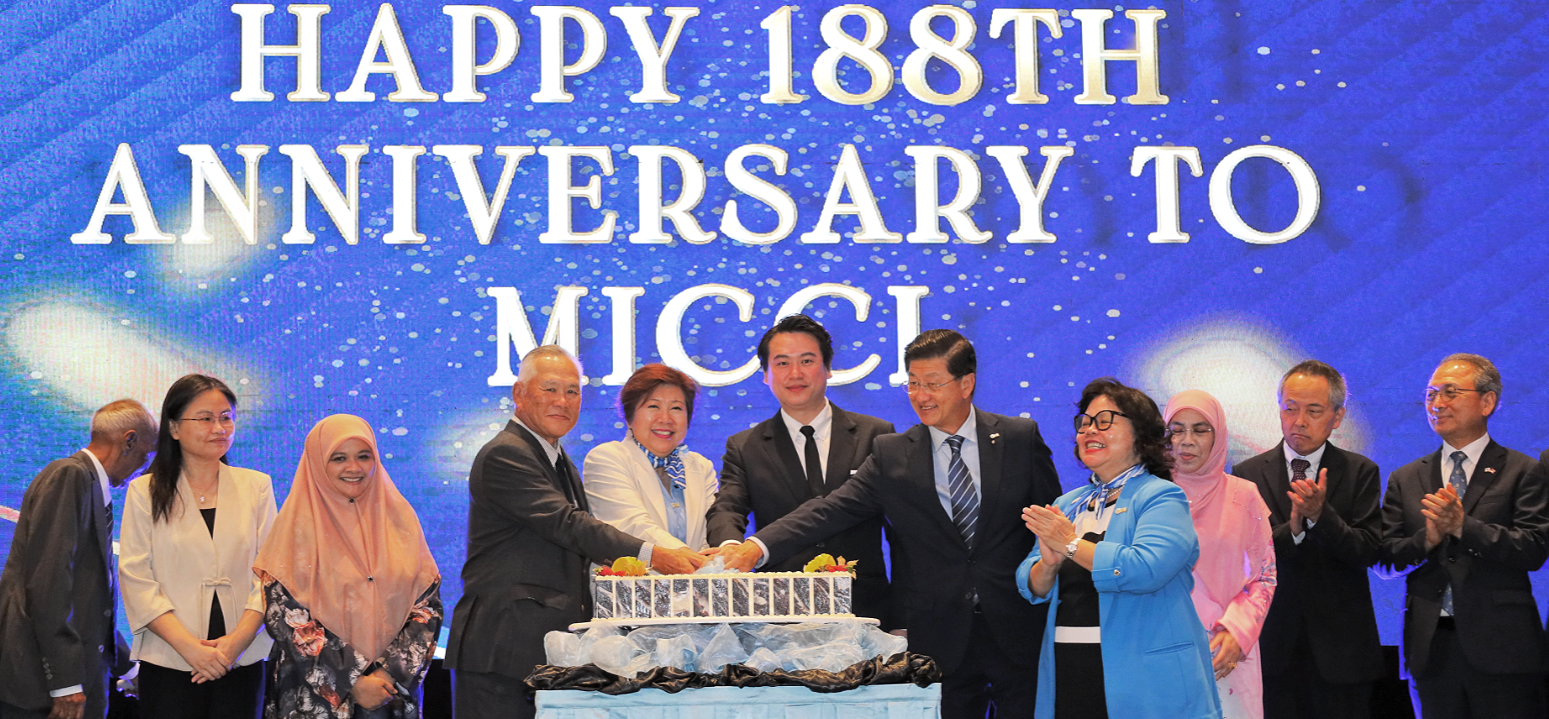
Mandela (sixth right) accompanied by MICCI Sabah Chairman Datuk Lee Swi Heng (fifth right) and committee members cutting the MICCI 188th anniversary cake at SICC today.
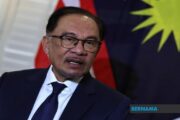
KOTA KINABALU: The State Government values the role of the Malaysian International Chamber of Commerce and Industry (MICCI) in the process of policy framing and decision-making, said Chief Minister Datuk Seri Haji Hajiji Haji Noor.
More importantly, he said MICCI has played a vital role as partner in progress to the Federal and State Governments in promoting a good business environment by developing and implementing a robust regulatory framework conducive to a healthy business environment.
Hajiji said MICCI had also played the leading role in the biennial Sabah International Expo, which has become a vital platform for promoting commerce, trade and investment for over two decades.
“With its formidable corporate membership across various business sectors from numerous countries and investments worth billions, the MICCI is a force to be reckoned with.
“Its resilience and history of support to members in developing their businesses in the country is commendable,” he said at the MICCI Sabah Branch annual luncheon 2025 at Sabah International Convention Centre (SICC) here today. His speech was delivered by his Senior Private Secretary, Datuk Ceaser Mandela Malakun.
Hajiji said the State Government’s commitment to addressing various challenges, including infrastructure and basic amenities, to spur economic growth, is evident by the highest-ever budget of RM6.42 billion this year.
Under the budget, he said RM2.6 billion has been allocated to upgrade various infrastructure and utilities, particularly those involving water, electricity and roads.
“We have put in place concerted action plans. Among these are the steps to help
transition the state’s dependence on non-renewable energy sources to renewable energy, where we have launched the Sabah Energy Roadmap and Master Plan 2040.
“To improve hydro capacity, we have launched the Ulu Padas hydroelectric project, which can contribute some 187.5MW and also has the potential to supply some 6,000 million litres daily (MLD) of water. Additionally, the capacity of existing water treatment plants have also been increased,” he said.
Hajiji said the State Government had established the Sabah Energy Commission (ECoS) as the regulatory authority for gas supply and energy to resolve energy woes.
He said the Sabah Ports Sdn Bhd had inked an agreement to jointly manage the
Sapangar Bay Container Port, along with investment in logistics and supply chain
infrastructure in Sabah.
“On the investment front, we have gained positive momentum. Sabah’s overall approved foreign and domestic investments in the manufacturing sector since September 2020 are estimated at RM17.41 billion from 73 companies.
“Of these 73 companies, 52 have already set up businesses in the state with a total
investment of RM7.8 billion, creating 3,636 jobs. From 2022 to 2024, Sabah also received new investment proposals worth an additional RM42.3 billion, offering 32,996 jobs,” he said.
Hajiji said apart from SK Nexilis and the Kibing Group, other investors included Esteel Enterprise Sabah Sdn Bhd with its RM19.6 billion investment, Curix Sdn Bhd (KKIP), Kibing Group’s third production line (KKIP), Tex Evolusi Waste Management Sdn Bhd (SOGIP) and E Concern (Borneo).
He said the Industrial Development and Entrepreneurship Ministry (MIDE) is also
currently coordinating the latest investment proposals from the Kibing Group at Kimanis, TS Asia Green Infrastructure Sdn Bhd at POIC Lahad Datu and PMB Technology/Press Metal in Sipitang.
“Overall, I am pleased to say that with all these investments in place, Sabah stands to gain RM58.319 billion worth of investments. Hence, the State Government will continue to progress this momentum to ensure that the state remains conducive for investors,” he said.
Hajiji said the Blue Economy, which was launched last year, is also expected to be a game changer in the state’s economic diversification.
“The Blue Economy is more than just deep-sea fishing. In fact, there are 14 components of the Blue Economy that can be explored. Among them are renewable ocean energy, blue carbon, tourism, maritime transport and marine biotechnology, among others. I look forward to seeing investments in this sector moving forward,” he said.