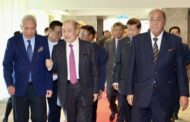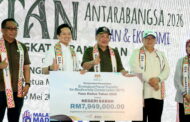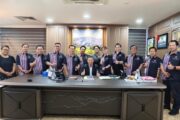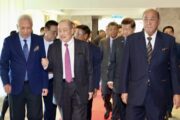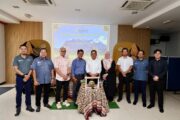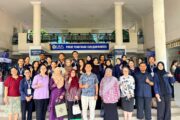


Goh (front row, third left) participating in the torch relay at the first stop of the National Chinese Cultural Festival in Limbang, with Goh (left) and Wee (right) next to him.
LIMBANG: The Federation of Chinese Associations Malaysia (Huazong) urged the Federal Government to give serious acknowledgement to the Malaysia Agreement 1963 (MA63) and to incorporate its historical content into the national education curriculum through the Education Ministry or the Higher Education Ministry.
Its President Tan Sri T C Goh, who made the call, said that this is necessary to ensure that Malaysians understand and accept this historical fact from a young age.
He said the MA6S is a crucial national agreement, and its content and historical process are essential parts of the country’s history.
“The historical significance should be widely understood and accepted not only in East Malaysia but throughout the nation.
“We do not want this historical fact to be neglected or intentionally overlooked. We hope the younger generation will fully understand this precious process of nation-building and have a correct perception and fair evaluation of the unique status and autonomy of East Malaysia,” he said.
Goh said this at the launch of the torch relay for the 39th National Chinese Cultural Festival, organised by Huazong and hosted by the Federation of Chinese Associations of Sarawak (FCAS) at 777 Car Park here Saturday.
Earlier in the evening, Goh also lit the cultural torch at the Limbang Leisure Park, witnessed by various Chinese community leaders. The torch was handed over to the Cultural Festival Organising Committee Chairman Dato’ Wong King Hoong, by Dato’ Wee Liang Chiat, Vice President of Huazong cum President of the FCAS (Sarawak), with the participation of 500 people in the torch relay.
The ceremony was officiated by the Deputy Premier of Sarawak and International Trade and Investment Minister, and Second Natural Resources and Urban Development Minister Dato’ Amar Awang Tengah, represented by the Deputy Food Industry, Commodities and Regional Development Minister Dato’ Abdul Rahman Ismail. Other attendees included Huazong Vice President Dato’ Lam Kuang Yau, Georgina Chong Wei Kiaw and Hee, Co-Chairs of the Cultural Festival Organising Committee; and Kapitan Capitan Kang, Chairman of the First Stop Torch Relay Organising Committee.
In his speech, Goh who is also President of the Federation of Chinese Associations Sabah (FCAS) hoped that Malaysians in the peninsular would have a deeper understanding of East Malaysia.
He also urged them to shed their misconception that people in East Malaysia still live on trees without clothes. He even expressed regret over the recent incident where a famous local carmaker incorrectly labelled Sabah and Sarawak during the launch of its new electric vehicle brand.
“Although the company apologised later, what’s the point? Such misconceptions or biases about East Malaysia need to be corrected through education over time,” he said.
He thus suggested incorporating the pertinent historical facts of the MA63 in the national education curriculum to ensure the public fully understands the formation of the Federation of Malaysia, and eliminating unnecessary superficial or shallow ideological perceptions about East Malaysia.
Goh also said that FCAS (Sabah) and its Sarawak counterpart fully support the continued pursuit of autonomy and rights under the MA63 by Sarawak and Sabah from the Federal Government.
“Although there may be differences in details and procedures, the overall principles and positions are consistent,” he said.
He hoped that the Federal Government would make greater efforts and speed, if necessary through constitutional amendments, to implement the MA63 and related documents, including the rightful proportion of seats for East Malaysia in the parliament, educational autonomy and net tax revenue or tax sharing.
Goh further noted that East Malaysia, consisting of diverse ethnic groups, has a more harmonious and friendly ethnic relationship compared to West Malaysia, despite significant gaps in infrastructure, development, and economic sectors.
He said that, unlike West Malaysia, East Malaysia does not frequently experience racial and religious tensions. Under the moderate leadership of government and community leaders of various ethnicities, East Malaysia has maintained excellent inter-ethnic relations, unity, and cooperation, which West Malaysia could learn from.
He also believed that the various ethnic cultures in East Malaysia could achieve better integration and mutual acceptance, reaching true inclusivity amid diversity.
Meanwhile, Awang in his speech read by his representative Abdul Rahman, said that Sarawakians are fortunate to live in a multicultural and harmonious society.
He said that by living together in a harmonious and respectful society, everyone can utilise this unity and rich life experience to promote progress and innovation in society, enhancing the country’s competitiveness on the global stage.
He was pleased to see the National Chinese Cultural Festival being held in Sarawak, with the torch relay in Limbang successfully organised through the efforts of various parties.
Wee in his speech acknowledged that different provincial Chinese associations in Sarawak had individually hosted the National Chinese Cultural Festival in the past. This year marks the first time the FCAS (Sarawak) has organised it together with the provincial Chinese associations, giving it greater significance.
He emphasised that the National Chinese Cultural Festival is one of the most important activities for the Chinese community, aimed chiefly at promoting Chinese culture and preservation of Chinese heritage, with different provincial Chinese associations taking turns to host it.
He said FCAS (Sarawak) would continue to actively promote Chinese culture, supporting Chinese education and fostering inter-ethnic exchanges and cooperation.
Wong in his speech said the torch relay for this year’s National Chinese Cultural Festival started from Limbang and will travel from north to south through Miri, Bintulu, Mukah, Kapit, Sibu, Sarikei, Sri Aman and finally end in Kuching with a series of grand performances.
He said the theme of this year’s cultural festival is “Cultural Prosperity, Multicultural Coexistence” fully demonstrating that the transmission of culture is not only respect for the past but also a commitment to the future.
“Transmission means protecting and promoting traditional arts, festivals and customs, most importantly, allowing the younger generation to understand and love their roots and origins,” he said.