

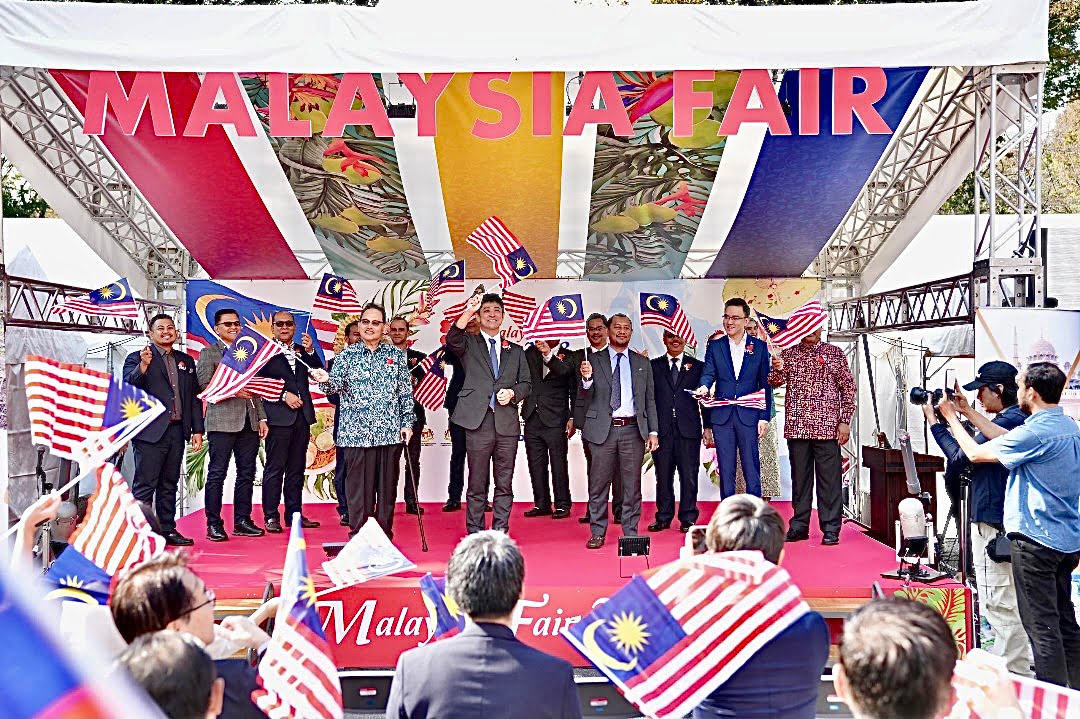
Phoong attending the opening ceremony of “Malaysia Fair 2023 in Tokyo”, which officiated by the Parliamentary Vice-Minister of Foreign Affairs, HE Komura Masahiro.
KOTA KINABALU: Several Japanese companies have expressed interest in investing in Sabah’s green industries, demonstrating the state’s potential and opportunities in the field of green industries, said Industrial Development and Entrepreneurship Minister Datuk Phoong Jin Zhe.
Green industries are one of the key sectors Phoong has been actively promoting.
He said interests were expressed to him during his recent four-day visit to Japan.
Also in his multi-agency delegation were Industrial Development and Entrepreneurship Ministry’s (MIDE) Permanent Secretary Datuk Thomas Logijin, Sabah Economic Planning Unit (UPEN) Director Datuk Jasmine Teo, Palm Oil Industrial Cluster (POIC) Sabah Sdn Bhd CEO Datuk Fredian Gan, Sipitang Oil and Gas Development Corporation (SOGDC) CEO Datuk Harun Ismail, Sabah Economic Development Corporation (SEDCO) Group General Manager Haizar Razif Hisyam, Department of Industrial Development and Research (DIDR) Director Tseu Kei Yue, Kota Kinabalu Industrial Park (KKIP) Sdn Bhd Deputy CEO Cecilia Amid and Chan Loong Wei, Political Secretary to the Minister.
Phoong revealed that in addition to business discussions with potential investors, a significant focus was participating in the “2023 Malaysia Fair in Tokyo” organised by the Malaysian Embassy in Japan.
Seven Sabah-based companies, led by DIDR showcased their products, successfully increasing the visibility of Sabah’s local products in the international market.
Phoong said that he is exerting every effort to open the path of industrialisation for Sabah.
“As everyone knows, without industrialisation, Sabah’s economic development will not succeed, and the people will not prosper. This is also the experience of China over the past forty years of reform and opening up,” he said.
Therefore, through active investment promotion, Phoong hopes to lay a solid foundation for Sabah’s industrialisation, which is essential for generating more employment opportunities in Sabah, allowing young people to realise their dreams without leaving their hometowns.
Phoong also emphasised that the primary purpose of attracting foreign investment is to facilitate “technology transfer,” training local youth in advanced technologies, enabling them to contribute to the creation of high-tech industries.
He drew parallels with China’s experience in reform and opening up, noting that China has now autonomously mastered superior and higher-tech capabilities.
Phoong also expressed gratitude for the fruitful outcomes of the Japan visit, thanking all civil servants and the officials who supported him and his team.
He affirmed his commitment to continuously bring about positive change for the Sabah and Sabahans.