

KOTA KINABALU: Sabah’s first 130-megawatt (MW) Artificial Intelligence Data Centre (AIDC) at Kota Kinabalu Industrial Park (KKIP) here will not draw on the State’s public electricity grid or municipal drinking-water supplies, ensuring that its operations will not affect resources meant for domestic consumers.
Managing Director of The North AIDC Sdn Bhd and The North Gas Power Sdn Bhd Datuk Sr Chua Soon Ping said the hyperscale, self-powered and liquid-cooled facility would generate 100 per cent of its electricity on-site using high-efficiency natural gas-fired engines supplied by Sabah Energy Corporation (SEC).
He said its cooling system would also use treated industrial water sourced from nearby Salut Bay instead of municipal drinking water.
“Our approach is to keep industrial cooling separate from drinking-water supplies. Our high-density liquid-cooling system uses coolant in closed loops, reusing the fluid to remove heat.
“For cooling, raw water from nearby Salut Bay will be treated through modular desalination and reverse osmosis systems provided by Shenzhen Yuehai Water. This produces industrial water for our closed-loop liquid-cooling system,” he said.
Drinking water for the centre’s engineers, staff and other personnel would be supplied separately by Jabatan Air Negeri Sabah.
Chua said the project marked a historic milestone for Sabah, being the State’s first 130MW self-powered, hyperscale, liquid-cooled AIDC, officially launched alongside the signing of strategic partnerships involving seven companies.
He said the facility was designed to support the growing demand for artificial intelligence computing, which relied heavily on Graphics Processing Units (GPUs) capable of performing many calculations simultaneously to train and run AI models.
Unlike conventional data centres, which primarily use Central Processing Units (CPUs) for general computing tasks, AIDCs require significantly higher computing power, generating intense heat that cannot be efficiently managed through air cooling alone.
The facility would therefore use direct-to-chip liquid cooling, with coolant circulating in closed loops to carry heat away and be recirculated for reuse, reducing the need for replacement water.
He said the wider Yuehai water group also operated the Dongshen Water Supply Project, a major source of raw water for Hong Kong, bringing substantial water-supply experience to the development.
Chua said the project was supported by four essential foundations: power, water, land and broadband connectivity.
The fully titled, flood-free site sits on a small hilltop within KKIP, with established access roads and industrial utility corridors. The land had been owned by the group for years.
On connectivity, he said the facility would have three core cable connections to Singapore, forming an important part of its international reach and access to a major regional digital hub.
Its connectivity profile provides for capacities of up to four terabits per second (Tbps) to Singapore, eight Tbps to Cyberjaya, four Tbps to Hong Kong, two Tbps to Tokyo, and one Tbps each to Jakarta and Los Angeles.
He said one Tbps was equivalent to 1,000 gigabits per second, providing substantial capacity for transferring AI datasets, accessing cloud platforms and serving customers across Malaysia, Asia and North America. The stated figures were maximum capacities subject to availability, with actual performance depending on services provisioned and network conditions.
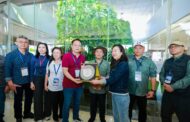
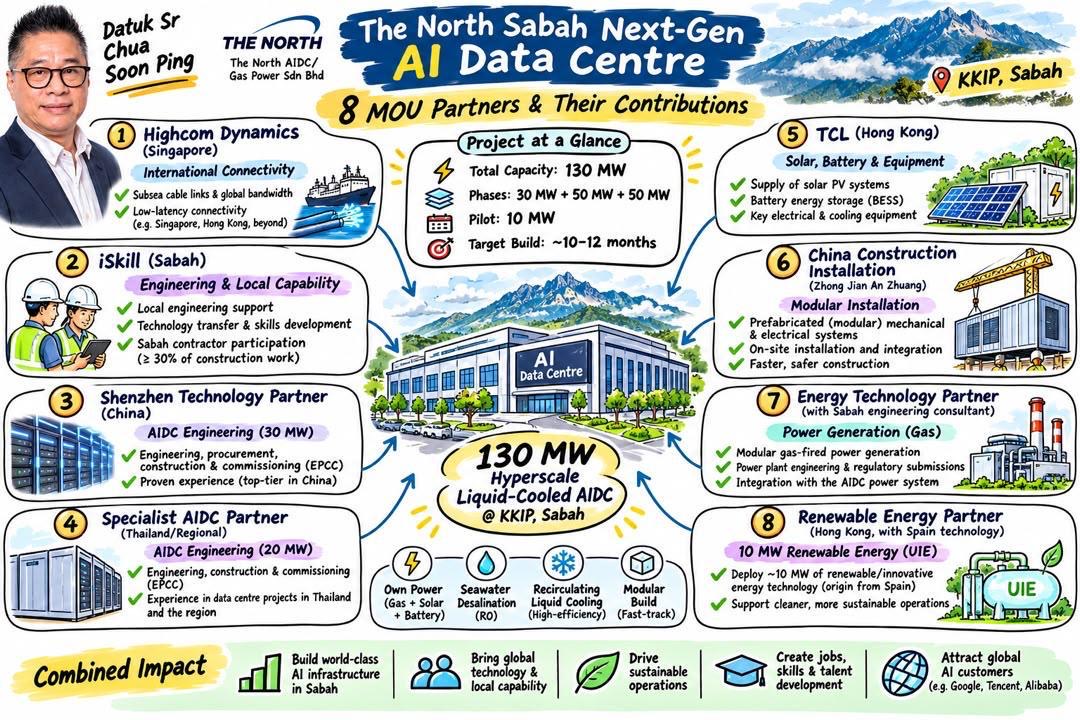
The seven partners involved in the strategic partnership signing are iSkill Dynamics Sdn Bhd, MEG Consult Sdn Bhd, Shenzhen Yuandong Zhiqi Technology Co Ltd, Shenzhen Weimingsheng Technology Co Ltd, TCL Home Appliances (HK) Co Limited, CCIE Engineering (M) Sdn Bhd and Hunan Liyu Gas Power Co Ltd.
Chua said MEG Consult, which had experience in 35 AIDC projects in Malaysia, most of them in Johor, would support the engineering design.
Shenzhen Yuandong Zhiqi Technology and Shenzhen Weimingsheng Technology would undertake engineering, procurement, construction and commissioning (EPCC) works for the 30MW and 20MW components respectively.
TCL Home Appliances would supply solar equipment, battery energy storage systems (BESS) and liquid-cooling equipment, while CCIE Engineering, the Malaysian company of China Construction Installation Group, would contribute its contracting expertise and modular installation capabilities.
Hunan Liyu Gas Power would supply modular gas generators, with each 40-foot container housing 2MW of generating capacity, allowing the power system to be delivered and installed in stages alongside the computing facilities.
He said the emphasis on modular delivery, covering construction, power generation, cooling and computing infrastructure, would shorten on-site installation and help bring capacity into service more quickly.
The facility, designed to support NVIDIA GB200 NVL72 and next-generation GB300 Grace Blackwell architectures, would feature modular computing spaces, plug-and-play liquid-cooling interfaces and customised power distribution to support efficient installation and future expansion.
Chua said Sabah could not afford to be left behind as technology advanced, adding that the project would establish a new AI industrial sector alongside the State’s strengths in agriculture, energy and tourism.
He noted that Sarawak had announced plans for the Kuching AI Data Campus, while proposals for data centre developments had also been announced in Bintulu.
Sarawak launched its Sovereign AI Infrastructure Platform in August, while SoftBank, Grab and PETROS signed a framework agreement in October to explore the development of AI and digital infrastructure in the State.
Johor had attracted more than 40 data centre projects, including operating facilities and those at various stages of development, while Selangor continued to expand its digital infrastructure, particularly in Cyberjaya.
“We welcome this progress. It strengthens Malaysia’s position internationally, and it demonstrates the scale of the opportunity that Sabah must also be able to pursue,” he said.
He said Sabah had made substantial contributions to Malaysia’s prosperity through its oil and gas resources and oil palm industry, supported by generations of local workers, smallholders, engineers and entrepreneurs.
He said these contributions should translate into meaningful development opportunities, including better infrastructure, access to investment and opportunities for Sabahans to acquire advanced skills.
“The significance of our AIDC extends beyond the buildings and equipment. It can help Sabah retain more value from its strengths by supporting businesses that use advanced computing, opening opportunities for local suppliers and giving our universities a closer connection to industry,” he said.
The 130MW facility aims to serve potential customers including Agoda, Tencent and Alibaba Cloud, among others.
Chua said it would strengthen local fibre infrastructure, attract technology vendors and create downstream opportunities in software engineering and AI services.
It could also encourage Sabahans currently working in Cyberjaya and Singapore to return home and pursue careers in the State’s growing digital economy.
To ensure young Sabahans benefit directly, he announced an annual AIDC Academic Scholarship Programme, with the Sabah Government entrusted to select 10 students each year.
The scholarships would cover Sabahans pursuing degrees in Computer Science, Data Engineering or Artificial Intelligence at any recognised university in Malaysia.
Each recipient would receive full tuition coverage and free computing token allowances throughout the four-year duration of their studies, enabling them to develop and train their own AI models.
They would also have opportunities to undergo industrial training at the AIDC, gaining practical experience and connecting their academic learning with industry requirements.
Chua said AI technology was expected to extend beyond computer screens into the physical world, citing NVIDIA chief executive Jensen Huang’s remarks at COMPUTEX 2024 that the next wave of AI would be physical AI.
Such technology could perceive its surroundings, reason and take action in real environments, with implications for factories, transportation and agriculture.
He also cited Elon Musk’s prediction at Y Combinator’s AI Startup School in 2025 that the world was approaching digital superintelligence, describing the prospect of AI surpassing human intellectual capabilities across a wide range of fields.
He urged the local business community to embrace AI and develop the necessary skills, warning that companies relying solely on unchanged operating methods and basic digital tools risked falling behind competitors.
“We must develop the skills to use these technologies, improve how our businesses operate and create services that customers will need in the years ahead.
“Let us prepare Sabah to take part in it and give our people the tools to help shape it,” he said.
He also expressed appreciation to Chief Minister Datuk Seri Haji Hajiji Haji Noor, Deputy Chief Minister II Finance Minister Datuk Seri Masidi Manjun, government agency partners and international investment delegates for their trust and support.