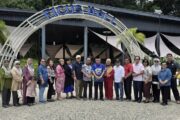


Rina, representing the Chief Minister, posing with the Sekolah Kebangsaan Membedai, Labuan team, champions of the Crime Investigation Challenge (Federal Territory of Labuan), at the Closing Ceremony of the Integrated STI Cultivation Programme at the Second Central Lecture Hall Complex, Universiti Malaysia Sabah (UMS), Kota Kinabalu, today.
KOTA KINABALU: Sabah aims to produce a generation that is not merely technology users, but is capable of understanding technology, developing solutions, creating value and developing innovations suited to the State’s uniqueness and needs.
Chief Minister Datuk Seri Haji Hajiji Haji Noor said mastery of Science, Technology and Innovation (STI) is no longer an option, but an important necessity to drive economic growth and improve the people’s well-being.
“In this situation, we cannot simply remain observers or technology users. We need to develop a generation that is capable of understanding technology, producing solutions, creating value and building innovations suited to the uniqueness and needs of our State.
“That is why we want to shift the scenario from merely being ‘technology users’ to becoming ‘technology creators’,” he said when officiating the closing of the Integrated STI Cultivation Programme at the Second Central Lecture Hall Complex, Universiti Malaysia Sabah (UMS), here today. His speech was delivered by Assistant Women, Health and People’s Wellbeing Minister Datuk Rina Jainal.
Hajiji said the rapid development of artificial intelligence (AI), automation, digital technology, biotechnology, space technology and renewable energy is reshaping the way people learn, work and conduct business.
He said mastery of STI is crucial to supporting the Sabah Maju Jaya (SMJ) 2.0 agenda, including producing a skilled workforce in AI, digital technology and high-impact strategic sectors.
“We do not want the people of Sabah to be left behind in the digital transformation that is changing the landscape of employment, education and economic development today and in the future,” he said.
He said Sabah has its own strengths through its rich biodiversity, natural resources, cultural diversity and broad economic potential, which can be further developed through research and innovation.
Among the areas, he said, are smart agriculture, food security, biodiversity, green energy, water resource management, healthcare, marine technology, science-based tourism and the digital economy.
In this regard, Hajiji said developing talent in Science, Technology, Engineering and Mathematics (STEM) is a vital long-term investment in preparing for future challenges, including the advancement of AI technology.
He said cooperation between the State and Federal governments, particularly through the Ministry of Science, Technology and Innovation (MOSTI), Sabah Ministry of Education, Science, Technology and Innovation (KPSTI) and UMS, needs to be strengthened to ensure the STI cultivation agenda is implemented continuously and comprehensively.
He said more programmes should be brought to schools and communities, including rural and interior areas, so that opportunities to gain exposure to science and technology are not concentrated only in urban areas.
He hoped the carnival would serve as a catalyst for more collaborative networks among schools, universities, government agencies, researchers, industry and communities through projects, training, competitions, mentoring, joint research and knowledge transfer.
Hajiji also wants innovation outcomes to be commercialised and utilised across various sectors, including helping to increase agricultural yields and facilitating business operations for small and medium industries (SMIs) in Sabah.
“Every effort we make today to bring the younger generation closer to STI is an investment in Sabah’s future,” he said, while urging parents and educators to continue supporting their children’s interest in STI.