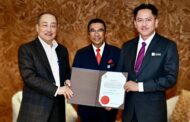


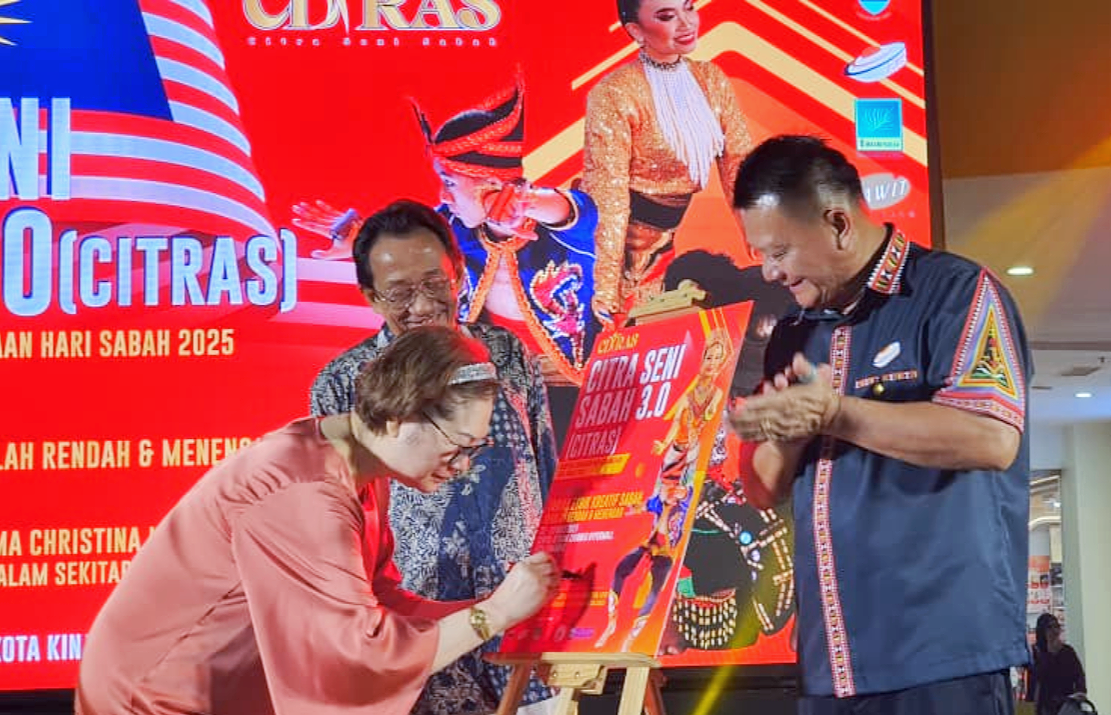
Liew signing a poster to officially open the CITRAS 3.0 programme, while Dikin (second left) and Mackey look on.
KOTA KINABALU: The Citra Seni Sabah (CITRAS) 3.0 programme is not just a platform for students to showcase their artistic talents, said Tourism, Culture and Environment Minister Datuk Seri Christina Liew.
She said more importantly, it plays a vital role in instilling patriotism and love for the country from a young age.
“The main objectives of this programme are to honour the sacrifices of our freedom fighters, preserve cultural heritage and instil a sense of pride in being Malaysian citizens.
“I am confident that the impact of the CITRAS Programme will shape a generation that is patriotic, appreciative of history and proud of their own cultural identity.
“Through creative approaches and direct student involvement, CITRAS 3.0 helps to raise awareness of our cultural diversity and the history of our national struggle, which must continue to be appreciated and inherited by the next generation,” Liew said.
The Minister said this effort aligns with the aspirations of the Hala Tuju Sabah Maju Jaya (SMJ) Development Plan, which emphasises the empowerment of culture as a foundation for harmony and social unity, adding as such, it is hoped that the organisation of cultural programs of this nature this will become an asset that contributes to the state’s future economic development.
She congratulated the Sabah Cultural Board (LKNS) and the Sabah Education Department on their commendable efforts in jointly organising a program that is highly significant in building the identity and character of the younger generation.
At this juncture, Liew expressed her appreciation to the Sabah Finance Ministry for its strong support in the organisation of CITRAS 3.0 this year.
This support, she said, not only reflects the Government’s concern for the development of the tourism and cultural sectors, but also highlights its commitment to uplifting the arts, culture and heritage of the diverse ethnic communities in Sabah.
“Therefore, investing in cultural programs such as this should not be seen merely as an expense, but as a long-term investment for the future of the state of Sabah, and ultimately, the nation of Malaysia,” she added.
Liew stressed that her Ministry welcomed smart collaborations between government departments, private agencies and non-governmental organisations (NGOs) in efforts to strengthen and elevate the cultural sector, especially at the grassroots level. “Such collaborative approaches are capable of strengthening the people’s identity, enriching local heritage, and reinforcing community unity through the spirit of cultural appreciation.”
On the participation of more than 400 students and teachers from five primary schools and five secondary schools across Sabah in the finals, the Minister said this overwhelming response reflects a strong interest from the younger generation in local arts and culture.
“Such efforts should be expanded and strengthened from time to time so that heritage values continue to flourish in the hearts of future generations,” she said.
Acknowledging the active involvement of schools, parents and the community in this programme, Liew said it also helps to strengthen the network of cooperation between government agencies and society, thus supporting efforts to integrate arts and culture into our daily life.
“I hope that the CITRAS programme will continue in the coming years with more exciting and diverse content, in order to uplift arts and cultures, and strengthen the unity of the people of Sabah,” she added.
Also present were LKNS Chairman Dikin Musah and its General Manager Mackey Apison.