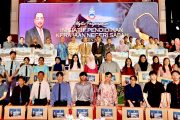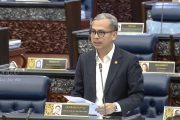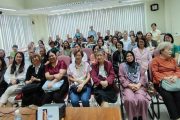


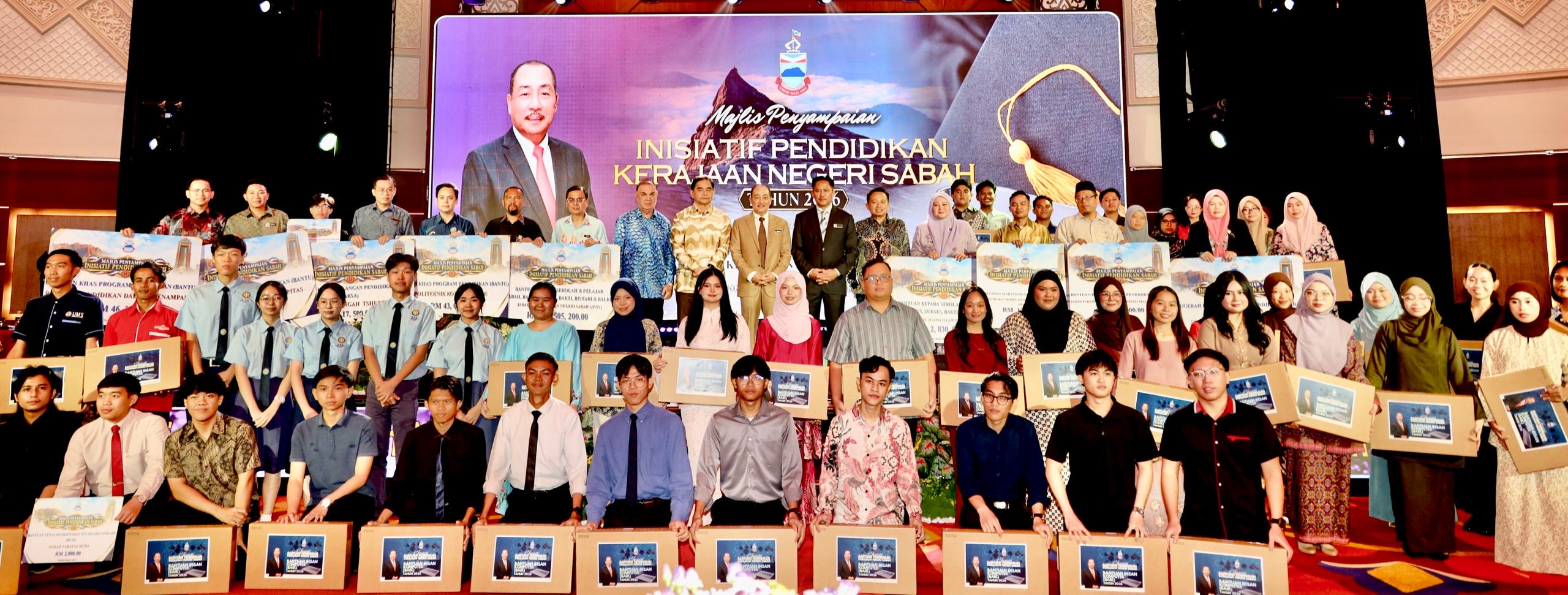
Hajiji and other guests with recipients of the Sabah Education Initiatives 2026.
KOTA KINABALU: The Sabah Government’s substantial allocation for education and human capital development programmes this year reflects its capability and strong commitment to championing the welfare of Sabahans and helping them progress.
Chief Minister Datuk Seri Haji Hajiji Haji Noor said the commitment also demonstrated the Government’s concern in ensuring that the education ecosystem in the State remained conducive, inclusive and competitive.
He said the efforts were further strengthened through the implementation of the Sabah Maju Jaya (SMJ) 2.0 Roadmap for 2026 to 2030, which serves as the main strategic plan to enhance Sabah’s competitiveness, productivity and economic value in a sustainable and inclusive manner.
“The State Government has placed human capital development as one of the key pillars of the SMJ Roadmap. This is because education is an important foundation in shaping the future of a state and nation.
“Education is also the key that can transform a family’s fortunes, eradicate poverty and subsequently propel Sabah’s development to a higher level,” he said at the Sabah Education Initiatives 2026 Presentation Ceremony at the Banquet Hall, Menara Kinabalu, here, today.
Hajiji said the State Government’s principle was clear, prioritising the ‘Sabah First’ agenda and guaranteeing access to education for all, without allowing Sabah’s children to be left behind in obtaining quality education.
He said although education was essentially under the jurisdiction of the Federal Government, the State Government had always adopted a proactive approach and worked closely with the Ministry of Education Malaysia (MOE).
He said the State Government’s main focus was to ensure fair and equitable access to education for all segments of society, regardless of family background, economic status or place of residence.
In this regard, various education assistance initiatives had been implemented to help students from low-income families, particularly through financial aid, scholarships and schooling support, to ensure that no child was left behind due to financial constraints, he said.
Hajiji said the State Government had implemented 14 education assistance initiatives, including the MUET Examination Fee Assistance (BAYU) for B40 students, benefiting schools, Parent-Teacher Associations (PTAs), students in higher education institutions (HEIs) and Sabah student associations locally and overseas.
“Of these, 13 initiatives under the Sabah Ministry of Education, Science, Technology and Innovation are being implemented this year with an allocation of RM87.5 million and will continue next year,” he said.
Among the initiatives are the One-Off Higher Education Institution Registration Cash Assistance (BUDI), Computer Assistance (BAIK), Special Examination Cash Assistance (BAKTI), State Education Savings Assistance (BISTARI), PTA Activity Assistance (BAGUS), Sabah School Assistance (BISBAH) and Minor School Maintenance Assistance (BALKIS).
Other initiatives include Special Education Programme Assistance (BANTU), Sabah Education Excellence Award (AKSA), Sabah Malaysia Student Secretariat (SEMESTA), Sabah Graduates Return Home Assistance or Sabah Student Flight Ticket Subsidy (GRS-SUBFLY), Higher Education Students Contribution in Sabah (SENTOSA) and One-Off School Activities Contribution (SUKSES).
Hajiji said that over the five years of implementing the assistance initiatives, the State Government had spent RM254 million, benefiting 141,635 HEI students and 277,124 school students.
The allocation also benefited 1,537 schools, including religious schools, 67 Sabah HEI student associations, while enabling 476 education programmes to be carried out.
In addition, he said education assistance was also channelled through several State Government agencies, statutory bodies and assistance organisations accessible via the Sabah Education Sponsorship Portal (PTPS).
Among them was the Sabah State Government Scholarship (BKNS), which provides scholarships and higher education sponsorships, with its allocation increasing nearly threefold to RM161 million as at Oct 31, 2026, compared with RM55 million in 2021.
Education assistance is also provided by Yayasan Sabah and the Sabah Islamic Religious Council (MUIS).
Hajiji said the State Government would continue to strengthen and improve various education assistance initiatives to ensure their delivery was more effective, transparent and reached the intended target groups.
He also urged all parties, including government departments, schools, educational institutions, parents and local communities, to work together in supporting the efforts for the future of the younger generation, who would become human capital, leaders and professionals contributing to Sabah’s and the nation’s development in the years ahead.