

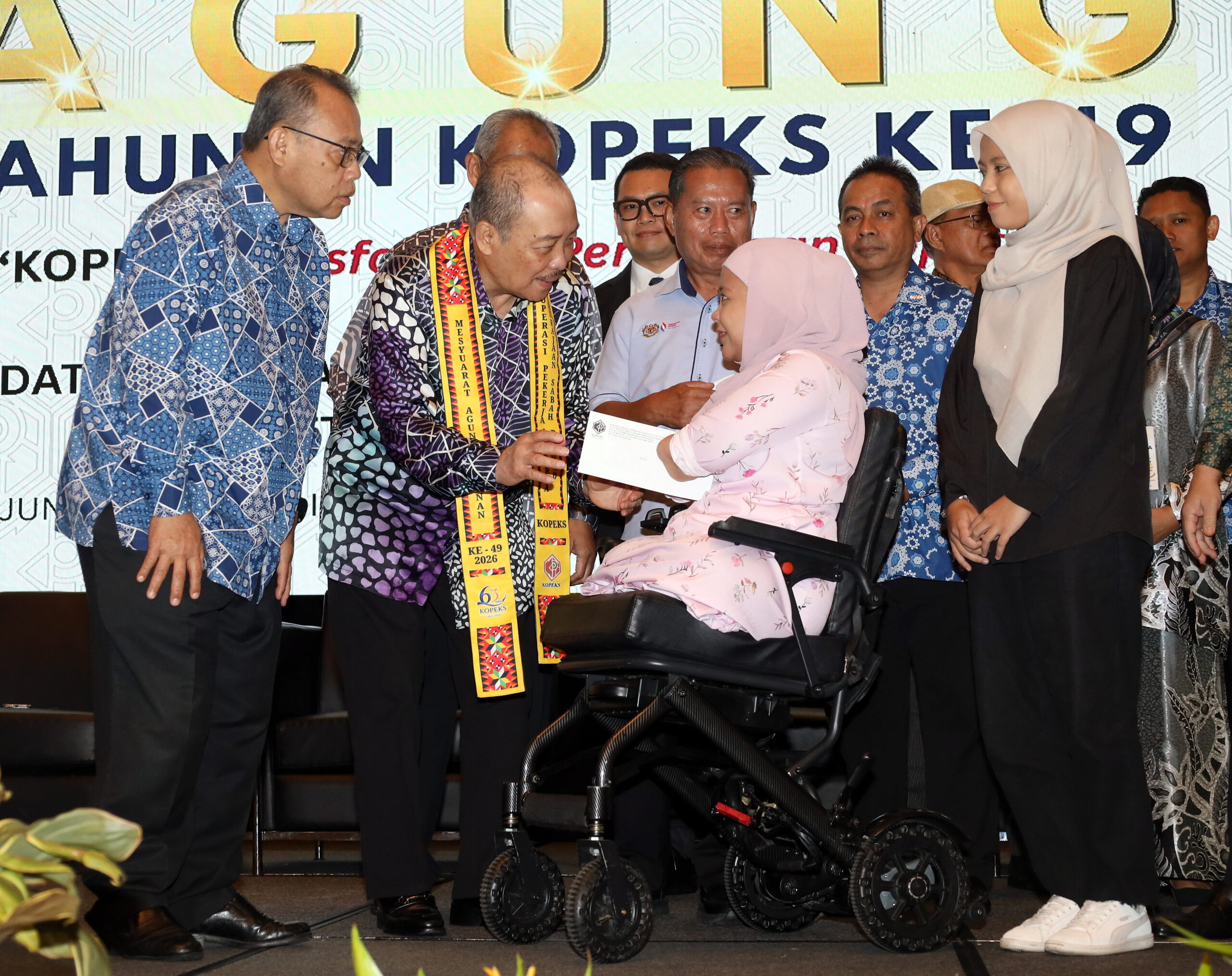
Hajiji, accompanied by KOPEKS Chairman Datuk Dr Saat Ag Damit, presenting KOPEKS CSR assistance after officiating at the 49th KOPEKS Annual General Meeting today.
KOTA KINABALU: Chief Minister Datuk Seri Haji Hajiji Haji Noor has called on the cooperative movement in Sabah to boldly undertake business transformation by diversifying income sources and exploring new sectors capable of generating added value for members, communities and the state economy.
He said that in an increasingly competitive economic and technological landscape, cooperatives can no longer rely solely on traditional business models. Instead, they must continue to innovate to ensure competitiveness and sustained growth.
According to him, business transformation will enable cooperatives to penetrate new markets, meet the needs of members and customers, and capitalise on emerging economic opportunities in line with current developments.
“The State Government strongly encourages cooperatives to continue strengthening their governance, expanding their business activities and serving as catalysts for inclusive and sustainable economic development.
“I am confident that the cooperative movement will remain relevant and continue to be an important contributor to the state’s development if it is always prepared to adapt to changing needs,” he said when officiating at the 49th Annual General Meeting (AGM) of Koperasi Pekerja-Pekerja Kerajaan Sabah Berhad (KOPEKS) and launching the Kinabalu Media community newspaper at Sabah International Convention Centre (SICC) here today.
Hajiji said KOPEKS should serve as an example for its courage in transforming from a credit-based business into various strategic sectors with high growth potential, including Ar-Rahnu services, healthcare, dialysis centres, housing projects, import and export activities, as well as community newspaper publishing.
He said the publication of Kinabalu Media demonstrates KOPEKS’ commitment to strengthening the culture of knowledge and providing a platform for the dissemination of credible information to the public, while also making a significant contribution to Sabah’s newspaper industry.
“In this rapidly evolving digital media era, print publications still play an important role in providing more in-depth reporting, quality analysis and documentation of various current issues.
“The State Government views the media as a strategic partner in efforts to develop the state and strengthen public unity, including advancing the Sabah Maju Jaya (SMJ) 2.0 agenda,” he said.
Commenting on KOPEKS’ involvement in the healthcare sector, Hajiji said the cooperative’s move to acquire several private clinics enables members to enjoy healthcare services at affordable rates, proving that cooperatives can play a greater role in enhancing public well-being.
He also welcomed KOPEKS’ plan to establish a dialysis centre, given the growing demand for such services, with the number of kidney patients in Sabah now exceeding 2,000.
He said the State Government had contributed 100 haemodialysis machines worth RM4.5 million to 23 government hospitals and two health clinics throughout Sabah in 2024 to help improve public access to treatment.
“I hope the dialysis centre to be established will offer affordable charges to help ease the burden on patients,” he said.
The Chief Minister said KOPEKS’ move into import and export activities, particularly with Brunei Darussalam, is a sound strategy for opening up cross-border trade opportunities, expanding markets for local products and strengthening regional cooperation networks.
According to him, the initiative is in line with the Sabah Maju Jaya agenda, which emphasises inclusive and sustainable economic development that benefits all citizens.
Meanwhile, Hajiji also expressed appreciation to the KOPEKS leadership for its encouraging profit performance in 2025 and its success in maintaining consistent dividend payments to members over the past 20 years.
He said the achievement reflects the cooperative’s efficient governance and financial management, enabling members to continue enjoying its benefits.
At the same time, he urged more civil servants, particularly the younger generation, to join KOPEKS in order to strengthen its position as a model cooperative that not only develops the economic well-being of its members but also contributes to Sabah’s overall progress.