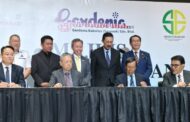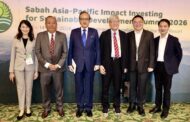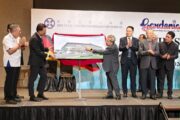


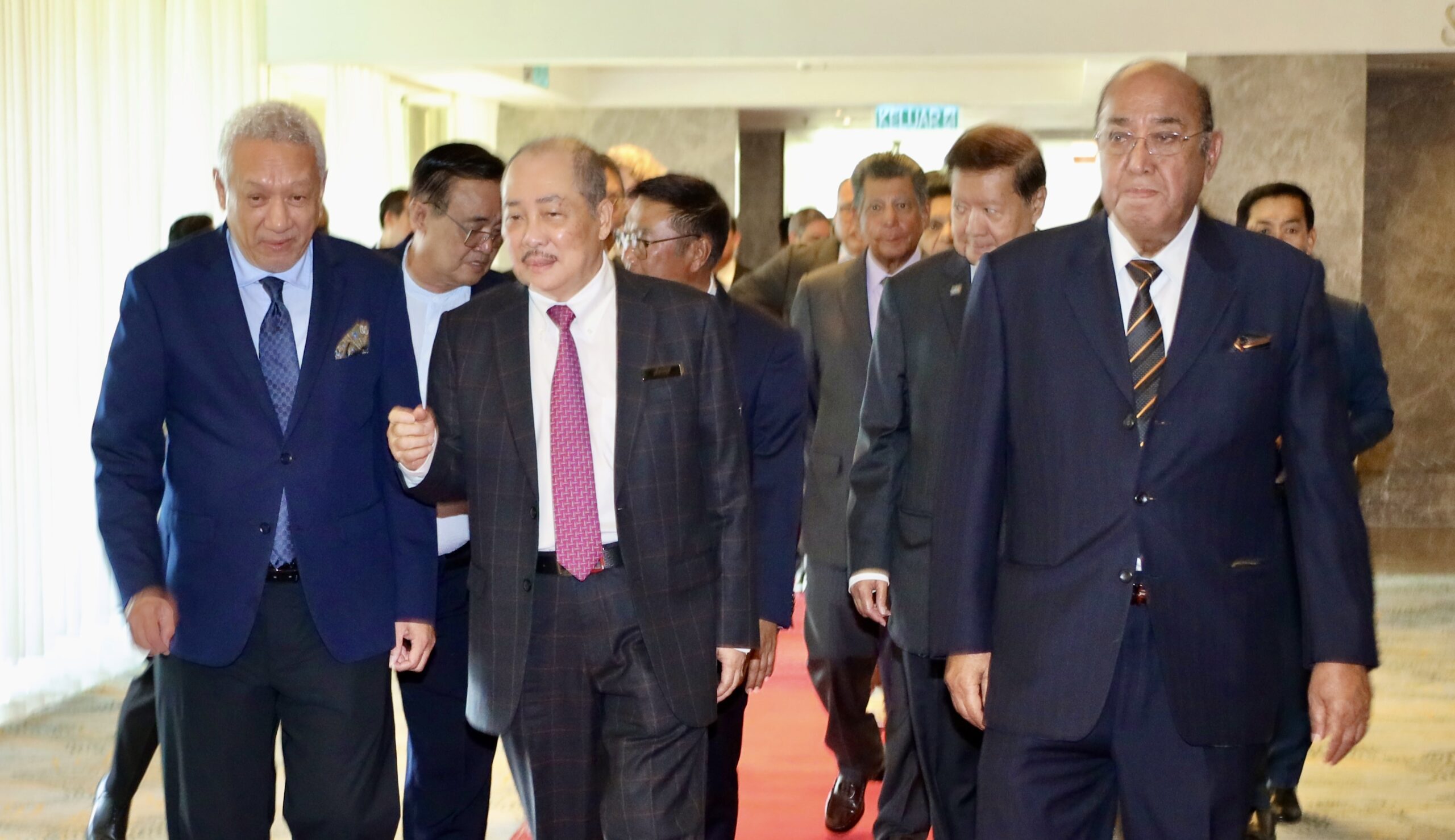
Hajiji (centre), flanked by Royal Government of Cambodia Senior Minister Dr Chhem Kieth Rethy (left) and KSI Strategic Institute for Asia Pacific Chairman Tan Sri Majid Khan, upon arrival at the WGSS at Shangri-La Tanjung Aru Resort today.
KOTA KINABALU: The State Government is adopting a balanced growth approach to address Sabah’s environmental and development challenges, said Chief Minister Datuk Seri Haji Hajiji Haji Noor.
“Sabah does not want development that destroys our environment. But Sabah also cannot accept an approach where environmental idealism delays the progress of our people.
“We must reject both extremes. We do not want reckless development. But we also do not want an unrealistic transition. The way forward for Sabah is a model of balanced growth.
“That is growth with discipline; conservation with value; investment with responsibility; energy transition with affordability; and sustainability with justice,” he said.
He said this when officiating at the World Green and Sustainability Summit (WGSS) at Shangri-La Tanjung Aru Resort here today.
Hajiji said although Sabah is a small state within a small nation, it possesses strengths and assets that are increasingly valuable in today’s world.
“We are blessed with rich natural capital and extraordinary biodiversity. We have vast land and maritime resources, energy potential, strategic geographical positioning, and political stability. Most importantly, we have a young generation ready to shape the economy of the future.
“The opportunities before Sabah are immense. Sabah has done exceptionally well in protecting forest reserves, preserving globally important biodiversity, and maintaining one of the highest proportions of protected land in this region.
“Today, Sabah is recognised as a leader in conservation, not only within Malaysia but across Southeast Asia, placing it in a strong position to attract responsible and sustainable investments,” he said.
Hajiji added that Sabah’s next phase of green growth is to move towards “conservation with value”.
“We are moving from protecting resources to building responsible industries around them. We are transitioning from being a green contributor to becoming a green economy leader.
“This includes developing credible carbon markets that benefit Sabah, attracting quality green investments that generate real economic value, and expanding industries in renewable energy, sustainable agriculture, the blue economy, eco-tourism, and biodiversity-based innovation.
“It also means ensuring local companies, workers and communities are part of the value chain,” he said.
He noted that long before sustainability became a global agenda, Sabah had already taken steps to protect its forests, oceans and wildlife.
“Today, nearly 30 per cent of Sabah’s landmass is designated as Totally Protected Areas, which is a significant commitment,” he said.
Hajiji said the WGSS serves as an important platform to discuss sustainability issues that impact people’s lives and future generations.
However, he stressed that sustainability must go beyond conference discussions and deliver real benefits on the ground.
“A green transition that is too costly for ordinary families is not sustainable. Policies that protect the future but burden the present must be carefully reviewed.
“A development model that appears strong internationally but weakens local competitiveness cannot be the right path for Sabah. Sustainability must be practical, fair, affordable and, above all, serve the people,” he said.