

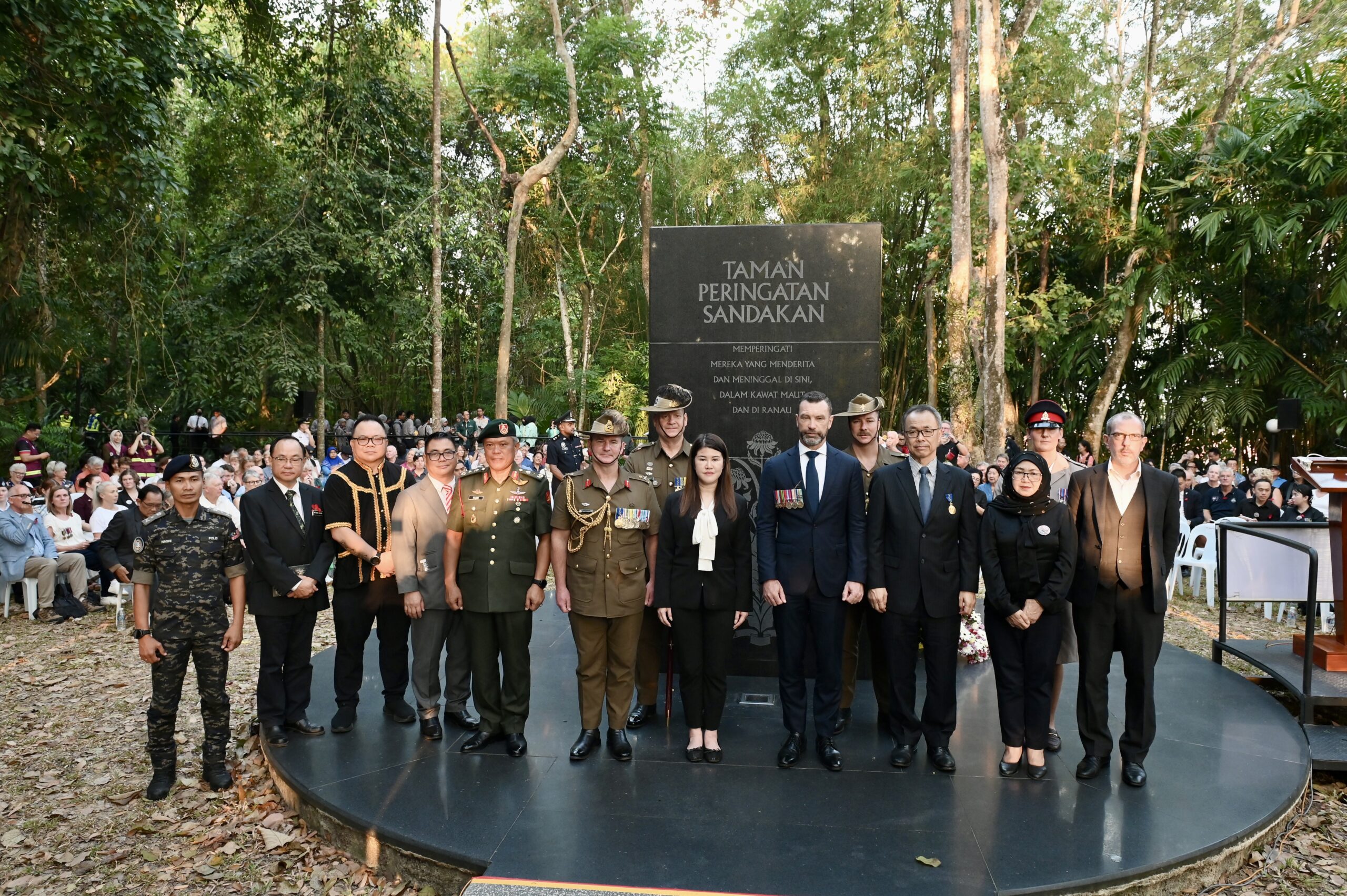
Wong (centre) with Simon Fellows, Deputy High Commissioner of Australia to Malaysia (sixth right) and other dignitaries at the Anzac Day Dawn Service.
SANDAKAN: Anzac Day stands as a tribute not only to prisoners of war (POWs) who suffered and perished during the Second World War, but also to the many others, including local Sabahans, who showed courage and compassion in the face of adversity, said Chief Minister Datuk Seri Haji Hajiji Haji Noor.
“Today, as we reflect on the shared histories of Australia, Britain and Malaysia, we recognise that the bonds between our peoples were forged not only through conflict, but also through compassion.
“The legacy of those who suffered in Sandakan is inseparable from the legacy of those who helped them survive, even if only for a short time,” he said at the Anzac Day Dawn Service at Sandakan Memorial Park here today. His speech was delivered by Sandakan Member of Parliament Vivian Wong Shir Yee.
Hajiji said thousands of Australian and British POWs endured brutal conditions in camps across Southeast Asia during the Second World War, including in Sandakan.
“The camps in Sandakan and Ranau became symbols of immense suffering caused by atrocities — cruelty, starvation, forced labour and the infamous death marches, which claimed the lives of nearly all who were held captive.
“Yet even in the darkest circumstances, humanity endured. Villagers and their families risked their lives to help the prisoners.
“We remember with pride the brave locals who took those risks to offer shelter and care. Each prisoner who survived owed his life to those who protected and supported him until rescue became possible.
“Helping these prisoners was a serious offence, punishable by beatings or death, but these villagers acted because it was the right thing to do,” he said.
The Chief Minister said the villagers’ bravery is a powerful reminder that even in times of great darkness, individuals can make a meaningful difference in the lives of others.
“Today, we honour the service and sacrifice of the men who were held as prisoners of war here.
“The humanity shown to them by the local people was a ray of hope in an unimaginably difficult time. Their memory endures as a lasting bond between our peoples,” he said.