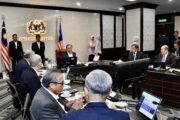


Hajiji chairing the MTS meeting.
KOTA KINABALU: Chief Minister Datuk Seri Haji Hajiji Haji Noor said Sabah’s energy transition initiatives are helping the state address challenges related to energy supply security and rising global oil prices amid the ongoing conflict in West Asia.
He said efforts led by the Energy Commission of Sabah (ECoS) and implemented over the past few years are both timely and well-positioned to cushion the impact of global energy uncertainties.
“The energy transition initiatives by the State Government are crucial in enabling Sabah to respond effectively to challenges arising from the conflict in West Asia,” he said when chairing the first Sabah Energy Council (MTS) meeting for 2026 at Menara Kinabalu here today.
He reaffirmed the State Government’s commitment to strengthening energy security through a balanced and resilient development strategy.
He said this includes leveraging Sabah’s natural gas resources, expanding hydropower development, adopting Battery Energy Storage System (BESS) technology, and exploring pumped storage hydro projects as large-scale energy storage solutions to enhance grid stability and flexibility.
“Sabah is now moving towards increasing the use of renewable energy and natural gas as alternatives to diesel and marine fuel oil,” he said.
Hajiji noted that a robust energy sector is a key driver in attracting investments and supporting industrial growth in the state.
“A stable, sustainable and competitive energy supply will continue to underpin the growth of strategic industrial areas, creating more investment and employment opportunities for the people of Sabah,” he added.
He said Sabah recorded several key achievements in strengthening its electricity supply system throughout 2025.
These include the completion of a 100 megawatt/400 megawatt-hour BESS project in August 2025 – the largest battery energy storage system in Southeast Asia – and the commissioning of the Sabah–Sarawak grid interconnection in December 2025, which enables the import of 50 megawatts of electricity.
Electricity supply reliability also improved, with the System Average Interruption Duration Index (SAIDI) reduced from 416 minutes in 2024 to 338 minutes in 2025.
“This encouraging improvement reflects continuous efforts by regulators, utilities, system operators and other stakeholders in enhancing the planning and operation of Sabah’s electricity supply system,” he said.
Hajiji added that the collapse of the 275kV Kolopis–Segaliud transmission tower due to a natural disaster in September last year underscored the need to strengthen grid resilience, particularly through sustainable generation development on the East Coast and the implementation of the Southern Link grid.
During the meeting, the council approved several intervention measures under the Sabah Rural Electrification Committee (JELaS) initiative to accelerate the achievement of full rural electricity coverage, in line with the Sabah Energy Roadmap and Master Plan 2040 (SE-RAMP 2040).
“These measures are aligned with the State Government’s strategy to build a resilient energy system through a balanced mix of renewable energy, natural gas and energy storage technologies.
“They will also enhance grid infrastructure, including the development of the Southern Link, particularly to improve reliability on Sabah’s East Coast,” he said.
Hajiji also announced the appointment of new council members, namely Deputy Chief Minister I cum Works and Utilities Minister Datuk Seri Dr Joachim Gunsalam, Deputy Chief Minister III cum Industrial Development, Entrepreneurship and Transportation Minister Datuk Ewon Benedick, and Sabah Energy Corporation Chief Executive Officer Datuk Ir Ts Adzmir Abd Rahman.