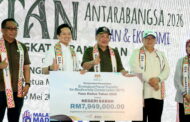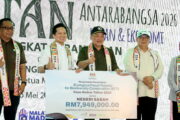


Dr Jeffrey (third right) representing the Chief Minister in launching LPBS.
KOTA BELUD: The Sabah Padi and Rice Board (LPBS) has been officially launched
with the primary objective of achieving the State Government’s target of increasing the rice self-sufficiency level (SSL) to 30 per cent by next year and 60 per cent by 2030.
Chief Minister Datuk Seri Haji Hajiji Haji Noor said various initiatives will be
implemented through the revival of LPBS to ensure Sabah’s food security, meeting the people’s food demands and reduce dependence on rice imports.
“Currently, Sabah can only produce about 22.8 percent of its local rice, resulting in a
high dependence on imported rice supplies to meet demand,” he said.
He added LPBS will take over all development and management of padi from the State Agricultural Department starting this year.
“In addition, LPBS has also been tasked as the regulator for the development and
management of padi. Therefore, I want all relevant state agencies to give full cooperation to LPBS,” he said when launching LPBS and Agrobank Padi Cultivation Takaful Scheme (STTP) at the Datuk Musbah Jamli Hall, here today. His speech was read by Deputy Chief Minister I cum Agriculture, Fisheries, and Food Industry Minister, Datuk Seri Dr Jeffrey Kitingan.
To boost SSL, the Chief Minister said the State Government will focus on the development and management of padi in six districts, namely Kota Marudu, Tuaran, Tambunan, Keningau, Papar and Kota Belud.
The total area of padi fields in these districts is 22,218.35 hectares or 55,879 acres, involving 16,018 padi farmers.
In addition to reviving LPBS, Hajiji said the State Government is also implementing
several other initiatives, including emphasising hill padi cultivation.
“Therefore, I call on all hill landowners to develop their land with high-quality hill padi cultivation. It is estimated that 13,266 hectares or 32,767 acres of hill land are suitable for padi cultivation, involving 15,617 farmers,” he said.
The Chief Minister said if fully developed, this area has the potential to produce 30,424 metric tons of hill rice annually.
Like Sarawak, famous for its Bario rice, Sabah too has its own hill rice variety, namely the Adan rice from Long Pasia, Sipitang, as well as from Ranau, Kudat, and Pitas, which have gained popularity in the local market, he said.
Hajiji also urged government-linked companies (GLCs) to develop their idle land for padi cultivation.
“I assure that the State Government remains committed to developing idle padi fields and boosting padi yields and local rice the production,” he said.
Hajiji called upon farmers to take advantage of the Padi Cultivation Takaful Scheme that protects padi planters in the country.
Under this scheme, padi farmers who are Malaysian citizens aged 18 and above,
farming in designated areas, registered under the Federal Government Fertiliser
Scheme, with an Agrobank account, will be protected for crop damage due to natural
disasters, pest attacks and diseases.