

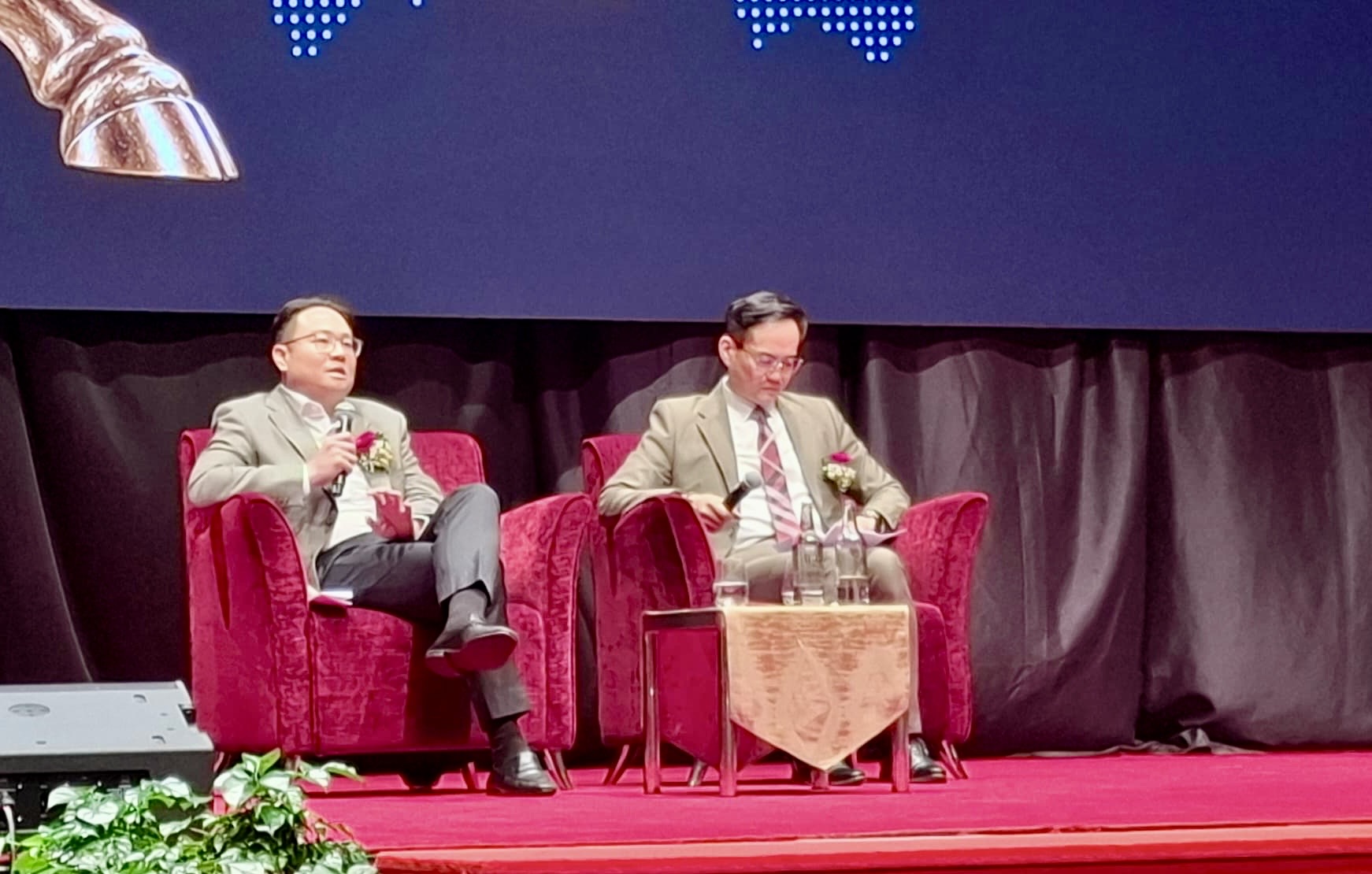
Lau (left) responding to questions from Yew, the session moderator, during the “Family Succession, Sustaining Breakthrough Growth” session, where he shared his experiences in third-generation succession, corporate listing and sustainable growth.
KUALA LUMPUR: Kim Teck Cheong Consolidated Berhad (KTC) Executive Director and Federation of Public Listed Companies Berhad (FPLC) Executive Committee member Datuk Dexter Lau shared his 26-year experience in managing a family business and his journey as a third-generation successor at the “Listing Strategy Summit” here.
Lau, who is also Malaysia-China Chamber of Commerce (MCCC) Sabah President, was invited to share his experiences and insights with entrepreneurs and business leaders from various sectors on leading a family business towards listing and sustainable growth.
The summit was organised by FPLC and officially opened by its President, Tan Sri Dato Sri Dr Peter Sow Chin Chuan.
Lau spoke during the “Family Succession, Sustaining Breakthrough Growth” session, where he shared his personal succession journey, family business continuity, the listing process, corporate governance and sustaining growth after listing.
Reflecting on his decision to leave his legal career to join the family business, Lau said it was not an easy decision initially.
With a legal background and experience as a lawyer, he said his mother had initially hoped he would continue practising law and pursue a professional career in an office rather than join the family’s traditional wholesale business.
He said his family was also initially reluctant about his decision to enter the family business, as the family had experienced disagreements and disputes over the years.
These experiences placed considerable pressure on him when deciding whether to become the third-generation successor.
Nevertheless, he eventually chose to join the family business and began by understanding its operations from the ground up.
Lau said that at every stage of a business journey, it was important to first do the present job well, adding that only after truly integrating into the business and understanding its operations could one gradually find one’s own direction.
“If you put your heart into it, stay humble and be very hands-on in what you do, I believe the direction will naturally find you,” he said.
He stressed that entrepreneurs should not blindly follow market trends or decide to list or adopt a particular business model simply because of friends, the media or external influences.
“What matters most is to manage one’s business and life well and find one’s own direction,” he said.
On family business succession, Lau said equity, the business itself, management control and the values established by previous generations were all essential elements.
Using bread-making as an example, he said if one important “ingredient” was missing, the quality of the final product would inevitably be affected.
He said while drafting his own will, he also took time to reflect deeply on business succession.
In his view, if the next generation inherited only equity but lacked management capabilities, resources or adequate support, they might not be able to manage the business effectively when facing external competition and other challenges.
After 26 years of managing the family business and experiencing family disputes, disagreements and various challenges, Lau said he realised that equity, management, the business itself and values must form a complete system to support long-term succession.
He stressed that a business leader’s responsibilities extended beyond managing revenue and costs to include operations, the board of directors, delegation and authority, the succession process, government relations and developing the next generation.
“People outside the family will always be watching whether the fourth generation can actually succeed the current generation,” he said.
He said this was also part of a business leader’s responsibility — not only to manage the business today, but also to create the conditions for the next generation to take over and continue the journey.
On managing a business involving multiple family members, Lau said leaders must first have their own convictions rather than expect every team member to immediately share exactly the same thinking.
He likened a leader to someone steering a ship, saying the leader must first be clear about where the business was heading before effectively deploying his or her philosophy and management approach throughout the organisation.
He said if a team merely underwent training and participated in various programmes without genuinely understanding the direction of the business, the resources invested might ultimately fail to generate the expected return.
Therefore, leaders must remain firm about their direction while ensuring the team understands and embraces the organisation’s core thinking.
When a business makes a wrong decision, he said the leader must also be capable of navigating, adjusting and correcting its course.
On KTC’s listing, Lau revealed that going public was not the goal he had originally set when he first entered the family business.
He said running a business was much like life, with different responsibilities and priorities at every stage.
After joining the family business, his first priority was to integrate himself into the organisation and understand the business before gradually finding his own direction.
Therefore, he did not begin with the assumption that the company had to be listed. Instead, as the business developed and its direction became clearer, the decision on which path to take gradually emerged.
He stressed that businesses should not pursue a listing simply because their friends had done so, because of media coverage or prevailing market trends.
“If you manage your business and your life well, your direction will naturally find you,” he said.
Asked whether he would regret pursuing the listing, Lau said if given the choice again today, he would still choose to list the company.
However, he acknowledged that the listing process was extremely challenging.
He recalled that he was relatively young at the time and had limited business networks, while listing requirements and procedures were highly rigorous and professional support was not as readily available as it is today.
During the process, he admitted there were moments when he considered giving up.
However, once news of the company’s intention to list was made public, external attention created pressure as well as motivation, compelling him to see the process through.
“You cannot give up halfway. You have to see it through,” he said.
He said going through difficulties repeatedly developed not only entrepreneurs’ problem-solving abilities, but also the willpower, perseverance and stamina required as business owners.
Lau said listing was not the end of a company’s development, with the real test being whether it could continue to sustain and grow after becoming a listed company.
He said the first thing he did in running the business was to continue investing his time and effort without stopping.
Business leaders, he said, had to manage numerous areas including business development, planning, execution, operations and various levels of management, requiring entrepreneurs to remain highly committed and engaged.
At the same time, he stressed the importance of taking a long-term view.
Any business initiative or development plan should be evaluated based on what it could contribute to the business over the next three to five years, as well as whether it could prevent competitors from gaining an opportunity to overtake the company.
At times, he said, a business might even have to sacrifice short-term profits in exchange for longer-term growth opportunities.
Starting from its traditional wholesale and distribution business, KTC has progressively expanded into sales, distribution, manufacturing, transportation and logistics, while continuing to develop its regional market presence.
Lau said businesses must continue to change as they grow, which he considered one of the reasons traditional businesses were able to sustain growth over the long term.
He jokingly noted that business owners were sometimes described as constantly “changing their minds”.
However, entrepreneurs were exposed every day to new information, business contacts, changing market conditions and evolving policies, meaning business decisions could not remain completely unchanged.
He stressed, however, that change must not simply mean following a trend.
Before changing a policy, strategy or business direction, a company must first ask whether the change was intended to support its development over the next three, five or even 10 years.
If a company changed simply because it saw someone else doing something and followed suit, he said, that was not genuine transformation but merely following the crowd.
On the risks accompanying change, Lau admitted he had also been afraid of making changes, as every change could bring unpredictable consequences.
However, he believed that when a business was already facing problems, not changing could itself become a risk.
If a company knew its existing approach could not improve the situation but continued to delay change because it feared the risks involved, the problem could worsen over time.
Therefore, business leaders must clearly understand why they were making a change, what they were trying to build and how long-term the benefits of that change would be.
He stressed that entrepreneurs sometimes had to withstand short-term pressure. Even if a listed company’s short-term performance was affected, leaders must remain committed to the right long-term direction.
For him, “doing what is difficult but right” was an important mindset for long-term business development.
At the end of the session, Lau was asked what advice he would give entrepreneurs who were already listed, planning to list or considering a listing.
He said there was no single answer applicable to everyone, as every entrepreneur had his or her own direction, life goals and aspirations.
He pointed out that there were also different forms and objectives of going public.
Entrepreneurs must first ask themselves: Why do I want to list? What do I want to achieve after listing? What do I really want?
Whether the objective was to become a major shareholder of a listed company or to bring one’s own business to the capital market, the decision should ultimately be aligned with the entrepreneur’s personal goals and sense of fulfilment.
Therefore, he said the most important thing was not to follow the crowd, but to find one’s own philosophy and direction.
“The most important thing is to know where your life goals and satisfaction lie,” he said.
He said this was also a principle entrepreneurs should hold on to when making major decisions concerning succession, listing and business growth.
The summit brought together speakers from listed companies, professional institutions and the business education sector to share insights on family business succession, capital markets, corporate governance, brand strategy, human capital and sustainable business growth.
It also provided entrepreneurs with a platform to exchange practical experience and explore opportunities in the capital market.
Besides Lau, other invited keynote speakers included A PLUS BOSS founder Dato Joe Yew Sin Yoo, SunZen Group Berhad Group Director Ching Chee Pun, BCB Berhad Executive Director Lindy Tan, SBS Nexus Berhad Managing Director and CEO Wong Chun Mun, Manforce Group Berhad Managing Director Dato’ Paul Wong Boon Ming and Baker Tilly Malaysia Managing Partner, Audit & Assurance Dato’ Lock Peng Kuan.
The luncheon forum also covered topics including international brand strategy, listing transformation and acquisitions, breaking through in the listed market and achieving growth during challenging times.