

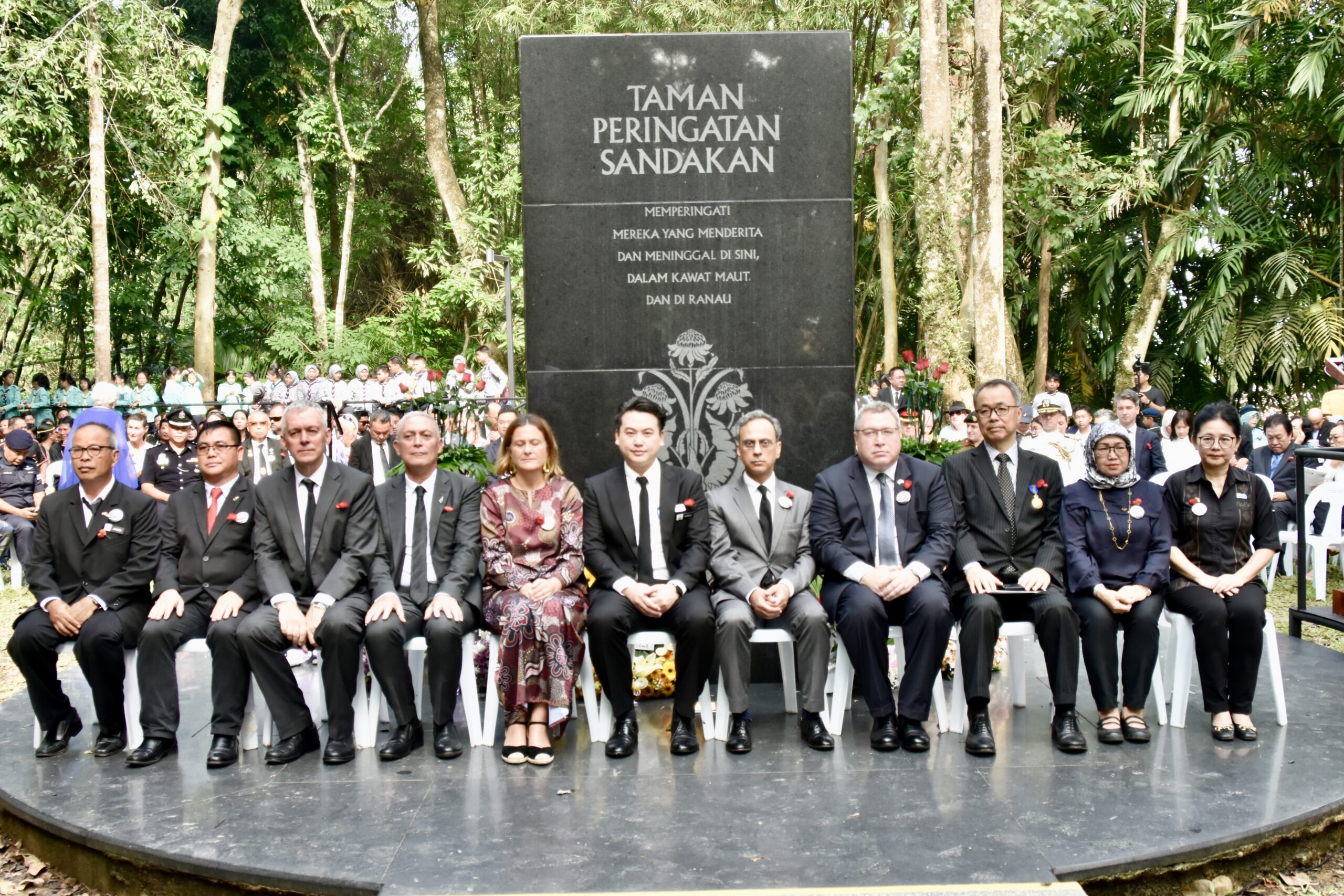
Mandela (centre) with the British High Commissioner Ajay Sharma CMG (fifth right), Australia High Commissioner Danielle Heinecke (fifth left), New Zealand High Commissioner Michael Wehi Mailetonga Walsh (fourth left) and invited guests at Sandakan Memorial Park after the service.
SANDAKAN: Chief Minister Datuk Seri Haji Hajiji Haji Noor said peace must be protected in practice by defending human dignity, resolving disputes without violence and refusing to ignore the suffering of others.
“We must reject the hatred, dehumanisation and indifference that made such suffering possible. This history must not be used to pass hatred to another generation. It must teach each generation where hatred can lead.
“Victory itself is never enough if we forget its human cost,” he said during the Sandakan Day Memorial Service held at Sandakan Memorial Park here today. His speech was read by Assistant Minister to the Chief Minister Datuk Ceasar Mandela Malakun.
Hajiji said that between 1942 and 1945, at the height of World War II, approximately 2,700 Australian and British prisoners passed through Sandakan during the infamous Death Marches to Ranau.
By January 1945, 2,434 remained: 1,793 Australians and 641 British servicemen. Of those men, 2,428 had died, with only six Australians surviving, each by escaping.
“Today, we also remember the six survivors: Bill Sticpewich, Dick Braithwaite, Owen Campbell, Keith Botterill, Nelson Short and Bill Moxham,” he said.
He said their survival was extraordinary, but they did not survive alone, particularly Owen Campbell, who was helped by two local men identified as Lap and Galunting at Kampung Muanud.
He said there were others whose names deserved to be remembered, such as Bariga, Dihil bin Ambilid, Abing, Kulang and many more whose courage may never be fully recorded.
“There were also organised efforts by local people, including Johnny and Lillian Funk and members of the Sandakan underground, who gathered information and helped prisoners despite the terrible risks. Some members of the underground were executed.
“They acted without protection and at great personal risk. When they saw suffering, they chose to help. Their courage is part of the history of Sandakan and of Sabah, and it must be remembered.
“Sometimes courage is a little food shared in secret. Sometimes it is a place to hide. Sometimes it is a canoe turning towards a man who has called for help,” he said.
Hajiji said this year marked the 81st anniversary of the end of the Second World War.
“Our responsibility continues after this ceremony. We must preserve the historical record, teach younger generations what happened here, and continue to speak the names of the prisoners and the local people who helped them,” he said.