


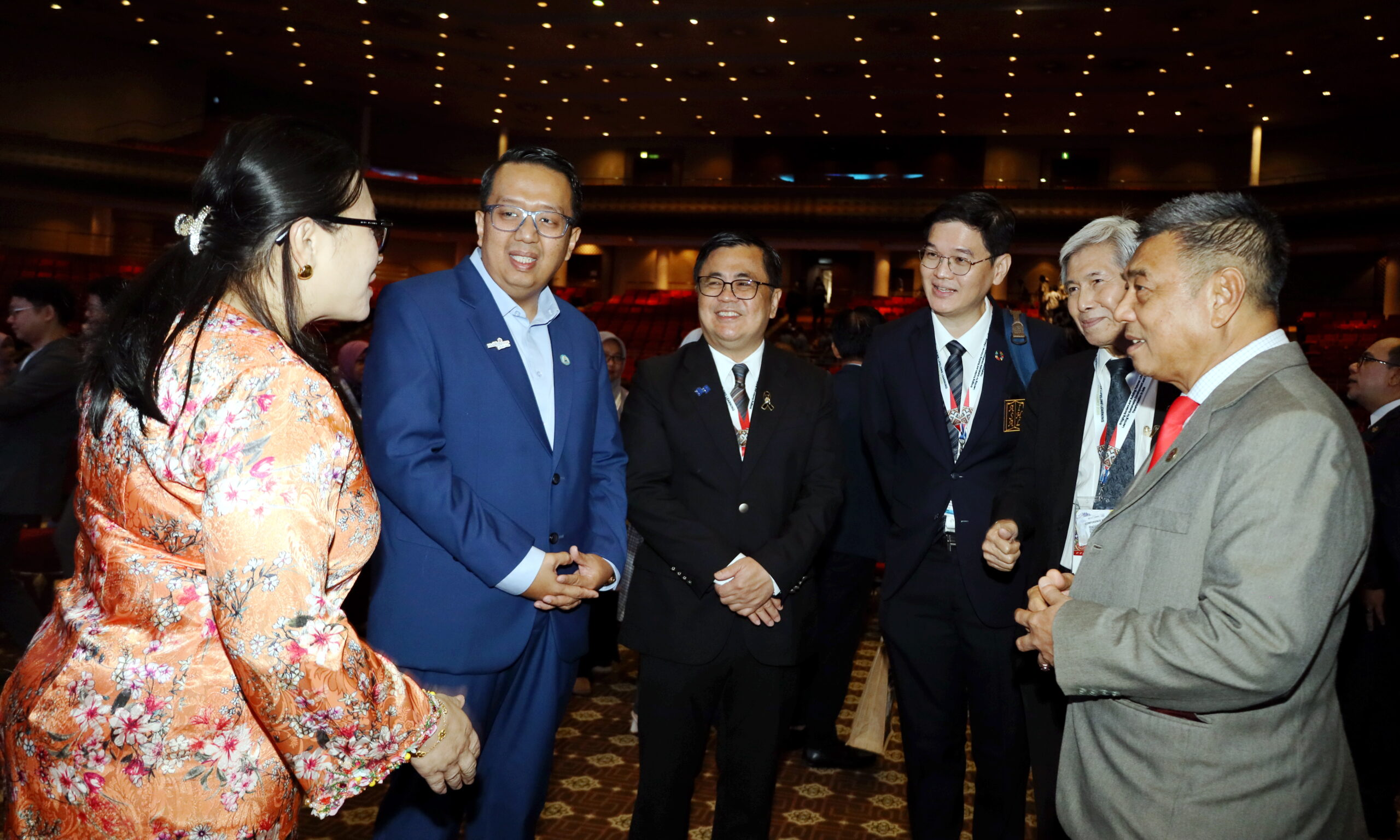
Dr Andi (right), accompanied by Universiti Malaysia Sabah (UMS) Vice-Chancellor Professor Datuk Dr Kasim Mohd Mansur, mingling with delegates during the Association of Southeast Asian Institutions of Higher Learning (ASAIHL) International Conference opening ceremony.
KOTA KINABALU: Chief Minister Datuk Seri Haji Hajiji Haji Noor has reaffirmed the State Government’s commitment to strengthening human capital development through the implementation of the Sabah Maju Jaya (SMJ) 2.0 Roadmap.
He said the initiative would help produce more skilled workers who are ready to meet the demands of future industries, particularly in the fields of artificial intelligence (AI), digital technology and other high-impact strategic sectors.
“This will help produce more skilled workers who are prepared to meet the needs of future industries, particularly in AI, digital technology and other high-impact strategic sectors,” he said when officiating at the opening of the Association of Southeast Asian Institutions of Higher Learning (ASAIHL) International Conference at the Universiti Malaysia Sabah (UMS) Chancellor Hall here today. His speech was read by Assistant Tourism, Culture and Environment, Minister Dr Andi Md Shamsureezal Mohd Sainal.
Hajiji said the conference theme, “Bridging Borders, Building Futures: Lifelong Learning for Sustainable Development and Digital Transformation in Asia”, is highly relevant in today’s era of rapid transformation.
He said Sabah faces a range of complex challenges in promoting lifelong learning, from its vast geographical landscape encompassing coastal areas, highlands and remote interior regions to its ethnically and culturally diverse population.
“We also face a digital divide between urban and rural areas. However, we have taken proactive steps to address these challenges, including encouraging collaboration among higher education institutions in Sabah, community colleges, vocational training centres and non-governmental organisations to expand access to continuing education,” he said.
According to Hajiji, the question is no longer whether lifelong learning is important, but how systems, partnerships and mindsets can be developed to make lifelong learning more accessible, equitable and effective for all.
He said AI is transforming the way people work, while the continuous emergence of new technologies requires industries and professions to adapt accordingly.
The integration of AI, big data analytics, machine learning and digital platforms into every aspect of life is reshaping education, commerce, governance and social interaction, he added.
“For universities across Asia, this presents extraordinary opportunities, but at the same time significant challenges.
“These opportunities lie in our ability to reach learners who were previously difficult to access through online platforms, micro-credentials, virtual classrooms and AI-assisted personalised learning,” he said.
Hajiji said he was pleased to see the participation of leading thinkers actively involved in digital transformation and educational innovation at the conference.
“I have been informed that the conference received 12 research papers from researchers across the region. This is the kind of intellectual engagement we need, one that can translate technological potential into educational reality,” he said.
He also welcomed the participation of delegates from eight countries, namely Malaysia, Indonesia, Thailand, the Philippines, Iran, Uzbekistan, Cambodia and France, at ASAIHL 2026.
According to him, the participation reflects a rich diversity of academic traditions, policy contexts and experiences.
“This diversity is not merely an organisational achievement, but also the foundation of strong international academic exchange,” he said.
Hajiji also commended UMS for its role in advancing lifelong learning, noting that through outreach programmes, professional development initiatives and community engagement activities, the university continues to strengthen its position as a lifelong learning partner for the people of Sabah.
“I hope more institutions and organisations that share the same aspirations will emulate such efforts in promoting lifelong learning,” he said.