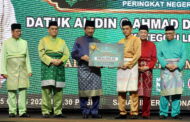


Tun Musa, accompanied by Dr Joachim Gunsalam presenting an award to a recipient during the Sabah Ethnic Day celebration.
KOTA KINABALU: The State Government has allocated RM174.45 million to the Ministry of Tourism, Culture and Environment (KePKAS), including its departments and agencies, this year to strengthen the tourism industry and safeguard Sabah’s cultural heritage.
Chief Minister Datuk Seri Haji Hajiji Haji Noor said the allocation is aimed not only at stimulating the state’s economy, but also at preserving cultural values and ensuring environmental sustainability.
He said a further RM38.70 million has been set aside to upgrade existing facilities and infrastructure, including the implementation of several key projects this year.
These include the upgrading of facilities at Petagas War Memorial Park, the construction of the Ranau Ethnic Museum, improvements to the Penampang Cultural Centre and enhancements to tourism products at the Murut Cultural Centre in Tenom.
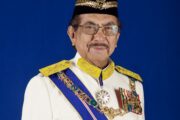
“The Government will also continue efforts to strengthen Sabah’s heritage and culture through the development of the Ethnic Cultural Mapping 2026–2030, to ensure the state’s ethnic diversity is systematically documented for reference by present and future generations,” he said at the Sabah Ethnic Day celebration, held in conjunction with the 75th Official Birthday of the Yang di-Pertua Negeri Sabah, at Sabah International Convention Centre (SICC) here today. His speech was delivered by Deputy Chief Minister I cum Works and Utilities Minister Datuk Seri Dr Joachim Gunsalam.
Head of State Tun (Dr) Musa Aman officiated the Sabah Ethnic Day event.
Hajiji said sustained efforts are essential to ensure that local cultures remain relevant in a rapidly changing world, while continuing to be preserved by the younger generation.
He expressed hope that ethnic associations across the state will continue to develop their respective cultures, customs and languages so that they do not fade into obscurity, while also strengthening cultural products as tourism attractions.
“These efforts are expected to help boost tourist arrivals and achieve the target of four million visitors to Sabah this year,” he said.
He added that Sabah Ethnic Day serves as a platform to celebrate the state’s rich cultural and ethnic diversity, as well as a symbol of harmony and unity among its people.
Now in its sixth year, the celebration also introduced a new highlight—a cultural parade featuring various ethnic groups from across Sabah.
“In line with this year’s theme, ‘Our Culture, Our Responsibility,’ it calls for a collective commitment to preserve and protect culture as the foundation of identity, social cohesion and the pride of our people,” he said.
He also conveyed appreciation to all parties, including ethnic-based cultural organisations and arts practitioners, for their contributions to the success of the event.
“Ethnic Day is not only a platform to showcase the richness of our ethnic heritage, but also a testament that differences in religion, culture and background are not divisions, but strengths that enrich Sabah’s identity and reinforce unity among its people,” he said.