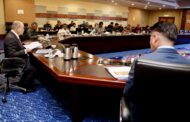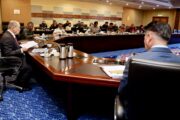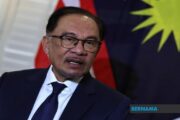


Masidi in discussion with USA Chargé d’Affaires to Malaysia David Gamble and US Assistant Secretary of State for Educational and Cultural Affairs Catherine Dillon upon arrival at the Sheraton Hotel.
KOTA KINABALU: Chief Minister Datuk Seri Haji Hajiji Haji Noor wants cooperation between Sabah and the United States of America (USA), shaped by mutual respect and shared interests, to be further strengthened.
“Sabah-US relations are not only about governments. They are about students, entrepreneurs, researchers, conservationists and communities working together.
“By building partnerships based on sustainability, opportunity and mutual respect, Sabah and the United States can contribute to a more prosperous and secure future.
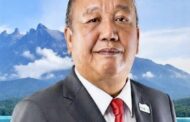
“Let us use this moment to deepen our cooperation, turn ideas into action, and transform opportunities into lasting success,” he said at the Freedom 250 reception to mark the USA’s 250th independence anniversary at the Sheraton Hotel here last night. His speech was delivered by Deputy Chief Minister II cum Finance Minister Datuk Seri Masidi Manjun.
As part of Malaysia, Hajiji said Sabah’s engagement with the United States takes place within the broader Malaysia-US partnership, creating opportunities in important areas such as trade, education, environmental conservation, tourism, innovation and maritime security.
“We celebrate the strength of this partnership and the exciting opportunities that lie ahead in Sabah. Sabah is more than a place of extraordinary natural beauty.
“Strategically located at the heart of Southeast Asia and connected to growing regional and global markets, it is a region of resilience, diversity, talent and ambition.
“From our rich natural resources and vibrant tourism sector to renewable energy, agriculture, manufacturing, digital innovation and the blue economy, Sabah offers meaningful opportunities for sustainable growth.
“Whether your interests lie in high-value agriculture, downstream processing, ecotourism, clean energy, logistics, digital services or sustainable resource development, Sabah is ready to work with genuine investors,” he said.
Hajiji said Sabah also recognised that progress could not be achieved by any one organisation or government alone, but was built through partnerships between the public and private sectors, local communities and international investors, innovators and industries.
“Strong partnerships create jobs, transfer knowledge, strengthen supply chains, and ensure that growth benefits people across Sabah. We therefore invite investors to be part of Sabah’s journey,” he said.
He said Sabah offered an environment where investment could deliver both commercial success and long-term impact.
“We welcome partners who share our commitment to responsible development, partners ready to build businesses, develop local talent, embrace innovation, and protect the natural heritage that makes Sabah unique,” he added.
Hajiji assured that the State Government remained committed to improving connectivity, facilitating investment and creating the conditions for businesses to grow with confidence.
“Investment in Sabah is not simply an investment in a market, it is an investment in a shared future, one that is inclusive, sustainable, and full of potential,” he said.
Hajiji said, based on history, the relationship between the United States and the people of Sabah began in 1865, nearly a century before the formation of Malaysia, when the then American Consul to Brunei, Claude Lee Moses, secured rights to an area near the Kimanis River and later sold the lease to two American investors, who established a settlement known as Ellena to farm coffee, pepper and tobacco.
In 1899, USS Bennington sailed into Sandakan for the first official visit of an American aircraft carrier to Sabah’s shores, while in 1912, American companies began exploring for oil here.
“Key American botanists came in 1914 to study our forests, and in 1920, two American documentary filmmakers, Osa and Martin Johnson, made major expeditions to British North Borneo (now Sabah) to film local wildlife and indigenous cultures.
“The Americans never stopped coming. Generations of Sabahans have learned from Peace Corps volunteers in our villages, Fulbright teachers in our schools, and American Corner programmes at Universiti Malaysia Sabah. American exchanges have given thousands of young Sabahans new skills and new confidence.
“And today, American companies such as ConocoPhillips, McDermott and Baker Hughes help us power our grid, employ our people, and support our schools and our clean water projects.
“In security as well, regular ship visits and exercises such as the Pacific Partnership have strengthened the safety of our waters and our people.
“In conservation, much work has been done in partnership with the State Government to benefit the Tun Mustapha Park, Danum Valley and the Bornean Sun Bear Conservation Centre to protect what makes Sabah unique, and to build a sustainable tourism industry around it,” he said.
“The Americans who came to Sabah more than a hundred years ago could not have imagined the Sabah of today. Neither can we fully imagine the Sabah going forward to the future. Still, the values that have carried this partnership across three centuries will carry it forward with trust, mutual respect, and a shared commitment to Sabah and our people,” he said.