

Dr Joachim receiving the Sabah Biodiversity Centre 2025 Annual Report from Sabah Biodiversity Centre Director Ken Kartina Khamis.
KOTA KINABALU: The Sabah Government is continuing to strengthen biodiversity governance, the bioeconomy agenda and biotechnology through the implementation of the Sabah Biotechnology Action Blueprint 2024–2034, said Chief Minister Datuk Seri Haji Hajiji Haji Noor.
He said the blueprint serves as the State’s strategic framework for harnessing Sabah’s rich biodiversity responsibly through science-based approaches to generate greater economic value, strengthen research and innovation, and develop a sustainable biotechnology industry.
“Through the implementation of this action plan, Sabah aims to link biodiversity conservation with socio-economic development while ensuring that biological resources and traditional knowledge are utilised sustainably and that the benefits are shared fairly and equitably among the people of the State,” he said.
Hajiji said biodiversity governance in Sabah continues to be enhanced through various initiatives, including the digitalisation of management systems and the protection of traditional knowledge.
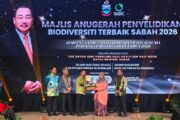
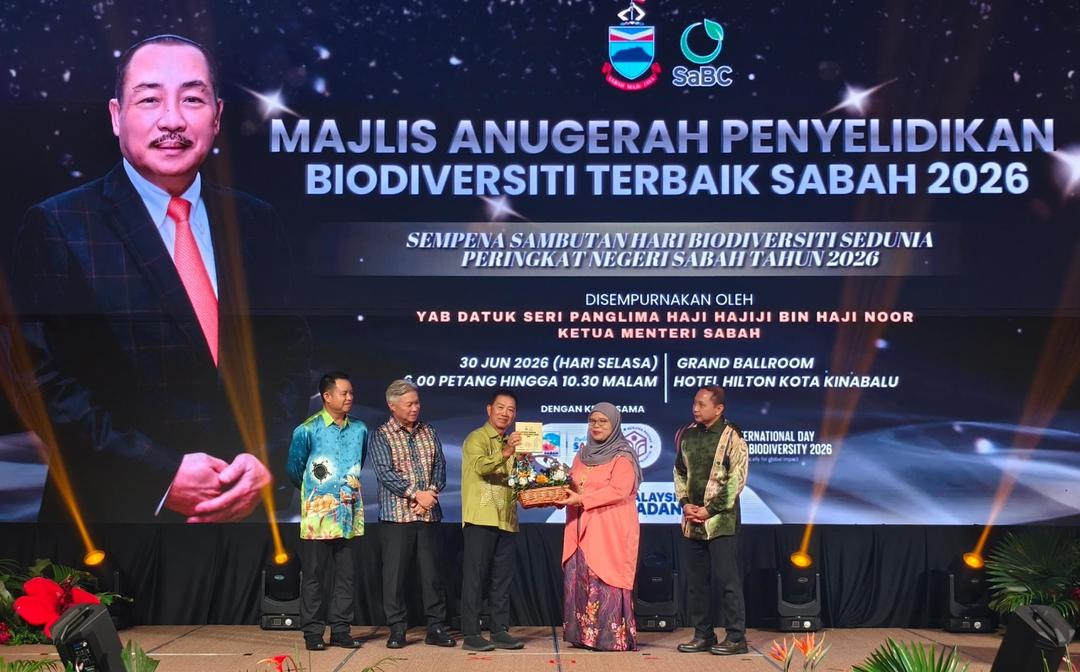
“This is to ensure that these invaluable resources continue to be preserved and utilised sustainably for present and future generations,” he said at the 2026 Sabah Best Biodiversity Research Awards ceremony held in conjunction with the State-level World Biodiversity Day celebration at the Hilton Hotel here tonight. His speech was read by Deputy Chief Minister I cum Works and Utilities Minister, Datuk Seri Dr Joachim Gunsalam.
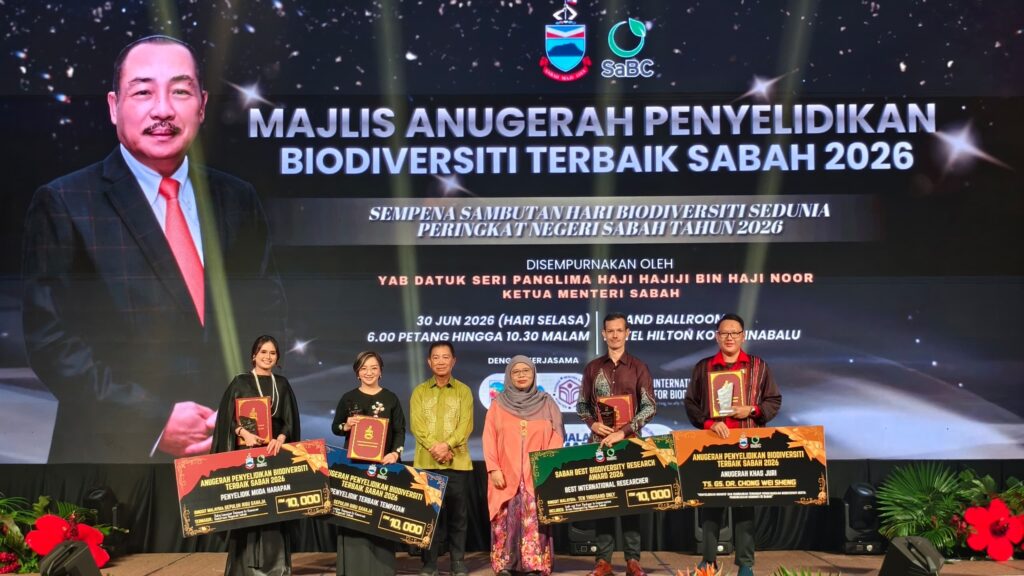
Dr Joachim Gunsalam with the award recipients.
Hajiji said this year’s World Biodiversity Day theme, “Acting Locally for Global Impact,” aptly reflects Sabah’s journey in demonstrating how local actions can generate significant international impact.
“Sabah is not only a state rich in biodiversity but is also among the regions playing a vital role in contributing towards the global biodiversity conservation agenda,” he said.
As proof of this commitment, he said Sabah has further expanded its Totally Protected Areas (TPAs) through the gazettement of approximately 216,000 hectares of new protected areas comprising commercial forest reserves and State land.
The move will increase the State’s total TPA coverage to 2.227 million hectares, representing 30.06 per cent of Sabah’s total land area. This achievement contributes towards Target 3 of the Kunming-Montreal Global Biodiversity Framework, which aims to ensure that at least 30 per cent of terrestrial, inland water, marine and coastal areas are effectively conserved and managed by 2030.
The Chief Minister said Sabah continues to strengthen its reputation as a premier destination for biodiversity research.
He noted that the DaMaI (Danum-Maliau-Imbak) Forest, comprising the Danum Valley Conservation Area, Maliau Basin Conservation Area and Imbak Canyon Conservation Area, has become a world-class biodiversity research hub that attracts both local and international researchers.
“The increasing number of applications for the State Biological Resources Access Licence under the Sabah Biodiversity Enactment 2000 also demonstrates Sabah’s recognition as a leading centre for biodiversity research in the region,” he said.
Hajiji added that numerous important discoveries, including the identification of new species and innovations, documentation of critical habitats and the development of conservation approaches, have resulted from research conducted in Sabah.
He also highlighted another historic milestone achieved through the signing of the first Benefit Sharing Agreement between the Sabah Government and Botanickel Sabah Sdn Bhd in September 2025.
The project focuses on environmental sustainability and efficient resource utilisation through innovative phytoextraction technology, involving the use of Sabah’s hyperaccumulator plants to extract nickel from the soil.
“It is expected to generate positive impacts for local communities through employment opportunities, economic activities, long-term agricultural contracts and ecotourism integration, while also sending a strong signal to researchers, investors and international industries to explore the vast potential of Sabah’s bioeconomy,” he said.
In line with the State Government’s commitment to strengthening research and innovation, Hajiji said the Sabah Best Biodiversity Research Awards had been introduced to recognise local and international researchers who have made outstanding contributions to advancing scientific knowledge on Sabah’s biodiversity.
“I hope these awards will continue to serve as a catalyst for more high-quality research that will elevate Sabah’s standing on the global stage while contributing to the ongoing conservation, protection and sustainable use of biodiversity at the local, national and global levels,” he said.