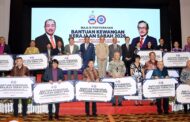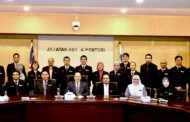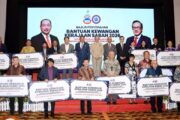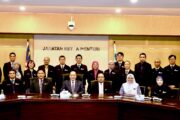



Joniston (centre) representing the Chief Minister during the launch gimmick, with Kota Kinabalu Mayor Dato’ Sri Dr Sabin Samitah (left) look on.
KOTA KINABALU: Coastal cities must balance economic growth with environmental protection and strengthen their resilience to climate change, said Chief Minister Datuk Seri Haji Hajiji Haji Noor.
He said coastal cities were important centres of trade, tourism and economic activity, but their proximity to the sea also exposed them to rising sea levels, extreme weather and pollution.
“These challenges cross borders. Our seas, ecosystems and economies are connected, and our responses must be connected too. We do not have to choose between prosperity and protection.
“By planning wisely and working together, we can build cities that are safer, cleaner and more resilient for generations to come,” he said when opening the Kota Kinabalu International Mayors’ Dialogue (KKIMD) 2026 at Sabah International Convention Centre (SICC) here today. His speech was delivered by Assistant Minister to the Chief Minister Datuk Joniston Bangkuai.
Hajiji said climate adaptation must also be integrated into everyday city management, covering drainage, sanitation, flood control, coastal protection and the restoration of mangroves and rivers.
“Nature-based solutions can help protect our communities and the ecosystems that sustain our Blue Economy,” he said.
However, he said implementing these priorities required funding and cooperation.
“Cities need better access to climate finance, public-private partnerships and other sources of support for green infrastructure and adaptation projects. They must also learn from one another. No city can meet these challenges alone,” he said.
Hajiji said the KKIMD 2026, which brought together participants from eight countries and 15 cities, including representatives from Indonesia, South Korea and the United States, was significant for Sabah.
He said Sabah was part of the Coral Triangle, one of the world’s most biodiverse marine regions, with its seas supporting livelihoods, food security and various maritime industries.
Protecting these marine resources was therefore essential for long-term economic sustainability, he added.
“The State Government’s commitment to balancing conservation and economic development is reflected in Tun Mustapha Park, where efforts are focused on protecting marine ecosystems while supporting local communities,” he said.
He said the same principle guided Sabah’s Blue Economy agenda, which sought to create sustainable opportunities in fisheries, aquaculture, marine biotechnology, maritime services, coastal and island tourism, marine renewable energy and logistics.
“Our objective is to develop these opportunities responsibly, so that Sabah’s seas continue to sustain both our economy and our communities,” he said.
Hajiji said the Blue Economy was also aligned with the Hala Tuju Sabah Maju Jaya (SMJ) 2.0 development roadmap for 2026 to 2030, which emphasised tangible benefits for the people through better economic opportunities, stronger livelihoods and improved public services.
“We are also advancing the Sabah Biotechnology Action Blueprint 2024–2034, which links biodiversity conservation with socio-economic development,” he said.
In this regard, he welcomed greater international cooperation and long-term investment in Sabah’s Blue Economy, green infrastructure and digital innovation.
Commending Kota Kinabalu City Hall for its Smart City agenda, Hajiji said technologies such as artificial intelligence, digital twins, geospatial tools and urban data platforms could improve flood warnings, land-use planning and public service delivery.
However, he stressed that digital transformation must remain people-centred, transparent and accountable.
He said the proposed Kota Kinabalu Joint Statement could establish a shared commitment to cooperation in the Blue Economy, digital governance, urban resilience and international partnerships.
The proposed KKIMD Network and annual progress review could also help translate these commitments into sustained action, he added.