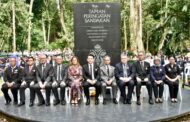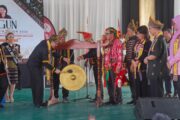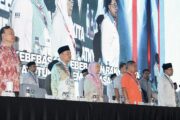


Masidi officiating at the opening of the Momogun Carnival.
KOTA MARUDU: Sabah’s Indigenous Peoples have an important role to play in the development of the state and should continue to participate in efforts to shape Sabah’s future, said Chief Minister Datuk Seri Haji Hajiji Haji Noor.
“For the State Government, the progress we pursue must take into account the interests of all segments of society, in line with the Sabah Maju Jaya aspiration to build a developed, peaceful and prosperous state,” he said when officiating at the opening of the Momogun Carnival in conjunction with the World’s Indigenous Peoples 2026 celebration at Dataran Kota Marudu today. His speech was delivered by Deputy Chief Minister II cum Finance Minister Datuk Seri Masidi Manjun.
The Chief Minister said the Federal Constitution itself recognises the position of the Natives of Sabah.
He said Article 153 of the Federal Constitution, among other provisions, provides for the responsibility of the Yang di-Pertuan Agong to safeguard the special position of the Natives of Sabah and Sarawak and the legitimate interests of other communities.
Therefore, the provision reflects the recognition accorded to the Natives of Sabah under the Federal Constitution, he said.
“In the context of the World’s Indigenous Peoples celebration, it also reminds us of the importance of preserving the identity, languages, customs, cultures and history of Sabah’s Indigenous Peoples as part of the state’s heritage,” he said.
“It reminds us that the languages, cultures, customs, arts and history inherited from previous generations are part of the heritage that shapes the identity of a community.
“In Sabah, this is particularly close to us. The state has long been home to various ethnic groups and Native communities, each with its own language, customs, culture and history.
“The diversity of these ethnic groups and Native communities is not something that divides us. On the contrary, this diversity is one of Sabah’s greatest strengths and forms the uniqueness of the state we love,” he said.
He stressed that the State Government has always respected the diversity of identities, terms and traditions used by the various ethnic groups and Native communities in Sabah.
Hajiji said the theme of this year’s Momogun Carnival in conjunction with the World’s Indigenous Peoples celebration, “Empowering the Well-being of Indigenous Peoples”, was highly appropriate, with efforts to ensure that the state’s development progresses in tandem with the well-being of the people.
“In this respect, well-being should not be viewed solely from the perspective of economic development. It also encompasses social harmony, the preservation of identity and heritage, education, human capital development and the ability of communities to adapt to change without losing their cultural roots and identity,” he said.
He said initiatives such as the Momogun Carnival also provided an opportunity for the younger generation to gain a deeper understanding of the languages, customs, arts, cultures and history inherited from their communities.
“At the same time, it provides an avenue for the wider community to learn about and appreciate the rich cultural heritage found in Sabah.
“In this regard, the United Nations Declaration on the Rights of Indigenous Peoples, or UNDRIP, is also an important international reference concerning Indigenous Peoples.
“Among the matters given emphasis under UNDRIP are the importance of the identity, languages, customs, traditions and cultural heritage of Indigenous Peoples, as well as their transmission to future generations.
“These principles remind us that development and the preservation of heritage do not necessarily have to be in conflict with one another,” he said.
Congratulating the Momogun National Congress, the Kota Marudu District Office, the Sabah Cultural Board and the entire organising committee on the successful organisation of the Momogun Carnival, Hajiji said: “Sabah is our shared home.”
“This state has been shaped by the diversity of its communities, languages, cultures and customs that have coexisted for generations.
“The State Government will continue to strive to ensure that the state’s development is implemented while taking into account the interests and well-being of the people as a whole,” he said.