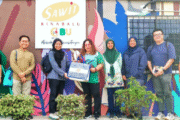


Philipa (fifth right) presenting a souvenir to the guests from Universiti Teknologi Malaysia’s Uni-Technologies Sdn Bhd and Tourism, Arts and Culture Ministry, recently.
KOTA KINABALU: The Sungai Pin Conservation Area (SPnCA) is set to gain international attention as one of the featured case studies in the upcoming ASEAN Handbook on Regenerative Tourism.
Experts say this recognition could put Sabah’s conservation-led tourism model firmly on the regional map.
SKG Green Sdn Bhd Chief Executive Officer Philipa Wilfred Mojilis said the inclusion of SPnCA signalled growing acknowledgement of Sabah’s efforts to integrate biodiversity conservation with responsible tourism within a production landscape.
She conveyed her pleasure at SPnCA’s selection for the ASEAN Handbook, receiving visits from Universiti Teknologi Malaysia’s Uni-Technologies Sdn Bhd and Tourism, Arts and Culture Ministry (MOTAC), and earlier, the Sabah Forestry Department.
“This handbook is expected to be circulated across ASEAN member states and international partners. To have SPnCA showcased in it is more than recognition, it is an opportunity for Sabah to share its conservation story with a global audience,” she said.

Philipa said SPnCA had grown into a flagship example of restoration, research, and community-inclusive tourism, demonstrating how palm oil landscapes could coexist with meaningful environmental protection.
“Regenerative tourism is not just about bringing visitors in. It is about leaving places better than we found them. SPnCA is living proof that production areas can host thriving biodiversity when we commit to responsible management,” she pointed out.
She added that Sawit Kinabalu, the parent company of SKG Green, had long recognised the importance of balancing economic development with the protection of natural assets.
“Your visit supports a regional effort that aligns closely with our vision for conservation-led and community-inclusive tourism. We hope the insights shared here will help shape a meaningful and impactful handbook for ASEAN,” she said.
In a separate address to Sabah Chief Conservator of Forests Datuk Frederick Kugan, Philipa highlighted the long-standing partnership between Sawit Kinabalu and the Sabah Forestry Department through a Memorandum of Understanding signed in 2017.
The MoU paved the way for the establishment of the 2,632-hectare SPnCA, voluntarily set aside by Sawit Kinabalu as a conservation zone within its plantation landscape.
“SPnCA is more than just a forest. It is a critical wildlife corridor, a green bridge for species such as orangutans and proboscis monkeys.
“Our collaboration has been built on shared responsibility, guided by science and strengthened by trust,” she stressed.
Philipa added that SKG Green has since translated the MoU into concrete action, planting over half a million trees and developing a formal management plan with technical guidance from the Forestry Department.
“The expertise from the Sabah Forestry Department team has been invaluable in ensuring our programmes align with the State’s conservation priorities. The Partners for Conservation Award we received earlier this year is really a recognition of our shared success,” she said.
Philipa also expressed hope that the field visit would deepen the partnership and open new avenues for joint initiatives.
“As we work towards positioning SPnCA as a regional example of regenerative tourism, collaboration remains our greatest strength,” she added.