

KOTA KINABALU: The Federation of Chinese Associations Malaysia (Huazong) was confident that China under the stewardship of President Xi Jinping and its new premier Li Qiang will continue to rise rapidly and peacefully.
Its President, Tan Sri T C Goh was also hopeful that under their stewardship, China will continue to propel regional and global economic growth, besides playing a significant role in stabilising the increasingly challenging and volatile global trade and geopolitics.
He thus hoped the four eyes meeting between Prime Minister Datuk Seri Anwar Ibrahim and his Chinese counterpart during his maiden official visit to China on this coming 29 March, will give rise to new and more strategic cooperation between Malaysia and China in order to better face whatever new challenges there are in this new era of globalisation.
He also disclosed that Huazong will be sending its delegation of leaders to accompany the Prime Minister in his official visit to China.
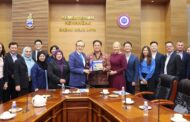
Goh, who is also President of the Federation of Chinese Associations Sabah (FCAS), said this while speaking at the welcoming dinner hosted by the Federation in conjunction with the official visit of Minister at the Chinese Embassy in Malaysia, Tang Rui, to Sabah on Monday.
Also in attendance were Huang Shifang, Tang’s colleague cum the Chinese Consul General in Kota Kinabalu, the Vice Consul General Ouyang Huifeng, Sabah Tourism, Culture and Environment Minister Datuk Christina Liew, Assistant Sabah Finance Minister Tan Lee Fatt, Senator Datuk Yong Teck Lee, Datuk Jimmy Yong Kyok Ming, FCAS Life Honorary President, its Deputy President Datuk Susan Wong Siew Guen, Vice Presidents Datuk Chua Soon Ping, Kapitan Lim Vun Chan, Kapitan Fung Chun Fatt, Ng Young Wah, Shirley Wong, and leaders of various Chinese organisations, among others.
Goh also congratulated the Government of the People’s Republic of China for its smooth and successful power transition recently, which led to the emergence of a new government led by President Xi Jinping and China’s newly appointed premier Li Qiang.
Goh, who is also an Advisor to the Sabah Economic Advisory Council (SEAC), also hoped the Sabah Government under the leadership of Chief Minister Datuk Seri Hajiji Haji Noor could conduct an official visit to China in near future.
“This will certainly help boost the rapport and cooperation between Sabah and China in various sectors, such as trade, tourism, culture and arts, etc,” he said.
He especially urged both the Federal and State Governments to step up effort to attract China investors of high calibre and technological advancement to come and invest in Sabah.
He was convinced that such a move could help accelerate economic recovery of Malaysia, Sabah included, post Covid-19 pandemic.
Meanwhile, Goh hoped the Government could better exploit Sabah’s long-established bilateral relations with China, especially citing the ancestral link between the Chinese community of Sabah and their ancestors in China, as well as Sabah’s strategic position in the ‘Belt and Road Initiative’ and the ‘Maritime Silk Road Initiative’, to bring rapid development and economic growth for Sabah.
“It is also worth mentioning here that, like Peninsular Malaysia, Sabah too has a sizable Chinese population, which is the second largest ethnic group in the state. Sabah also has nine Chinese independent schools which are run by the Chinese community, coupled with 83 Chinese middle schools and primary schools, and the national and local Chinese newspapers, Chinese organisations of various characteristics, and Chinese religious organisations, which essentially forms the Chinese community of Sabah,” he pointed out.
He also commended the State Government for giving its full support and cooperation when China decided to establish its consulate general in Kota Kinabalu back in 2015.
He acknowledged that the strong support and cooperation given by the Chinese Embassy in Malaysia and the Chinese Consulate General in Kota Kinabalu, had over the years helped to bring in many China investors and tourists to Sabah, which essentially helped propelled economic growth and developments in Sabah.
“Over the years, with the establishment of direct flights between Sabah and China, places like Kota Kinabalu, Mt. Kinabalu and Semporna have become popular destinations for Chinese tourists. This has obviously further strengthened the bilateral ties between Sabah and China,” he said.